
Often known as the “Oscars of the design world”, the Red Dot Award is one of the most influential design competitions globally, attracting thousands of entries each year. In 2025, students from Taiwan Tech once again delivered an outstanding performance, winning a total of three awards - one Best of the Best and two Red Dot Winner honors. These achievements highlight the exceptional creative strength of NTUST students and mark the university’s fifth consecutive year at the top of the Asia-Pacific Red Dot Design Rankings.
This year’s award-winning projects include Memory and Craftsmanship, which connects mud-dyeing techniques with local land and cultural heritage; Lume, an interactive design that reinterprets farewell rituals in Chinese culture; and Qing Jing Farm, a brand identity redesign centered on the concept of “home” for Qingjing Farm.
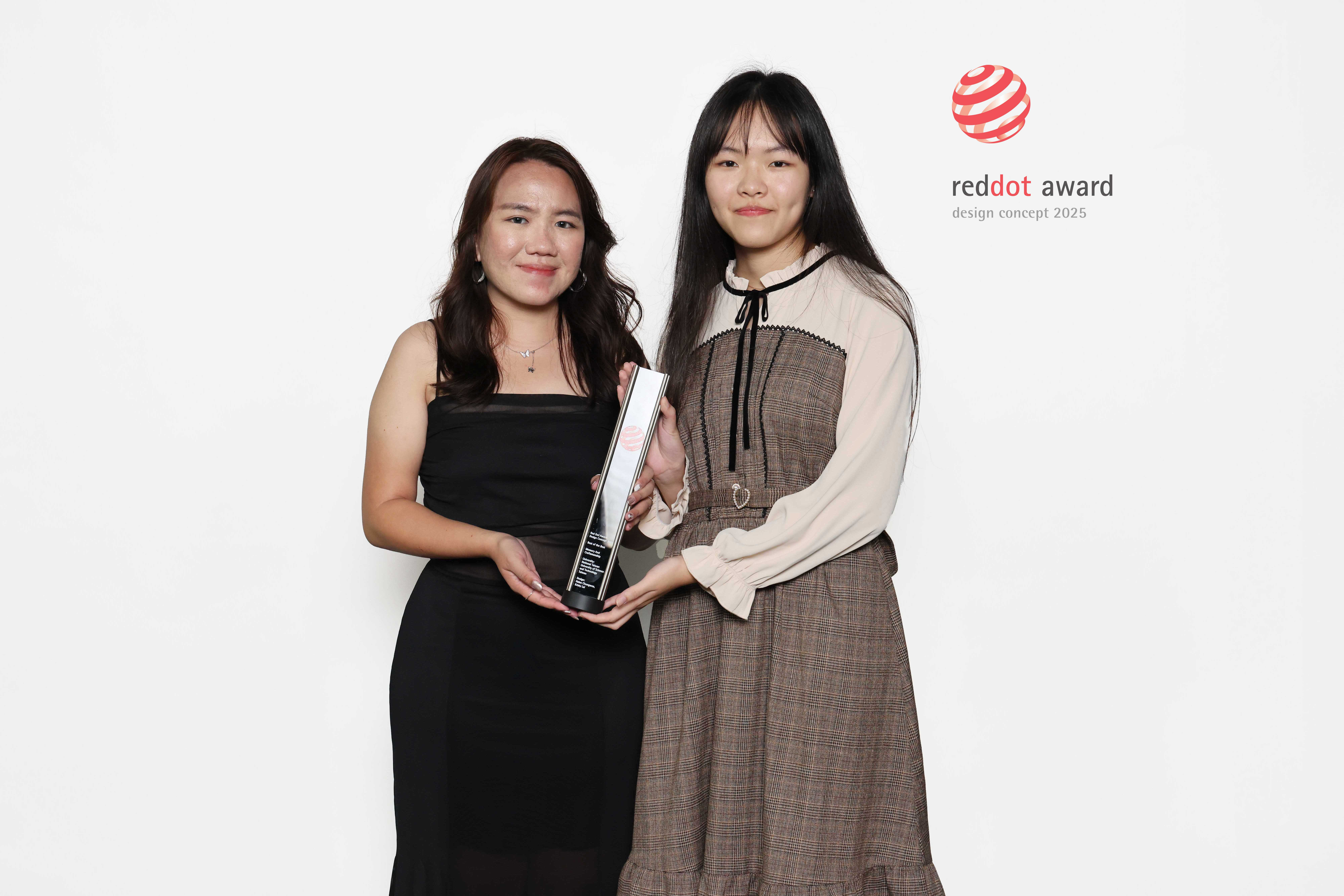
Under the guidance of Professor Tsu-Huai Yang, Taiwan Tech Department of Design students Yi-Hui Lai (left) and Chung-Wen Hsiao (right) won the Best of the Best award in the Design Concept category with their book project Memory and Craftsmanship.
Memory and Craftsmanship, co-created by Chung-Wen Hsiao and Yi-Hui Lai, centers on natural mud dyeing and approaches the subject from three key perspectives: the memory of the land, the spirit of craftsmanship, and the transmission of traditional skills. The project reveals the beauty of this traditional dyeing technique, which is gradually fading from contemporary practice.
Structured around five color-themed chapters - gray, indigo, cinnabar, persimmon, and brown-the work explores dyeing techniques, patterns, and possibilities for cultural and creative applications. The book features a hand-dyed mud-fabric cover that preserves natural folds and textures, resulting in an accessible introductory volume that invites readers to better understand mud-dyeing culture.
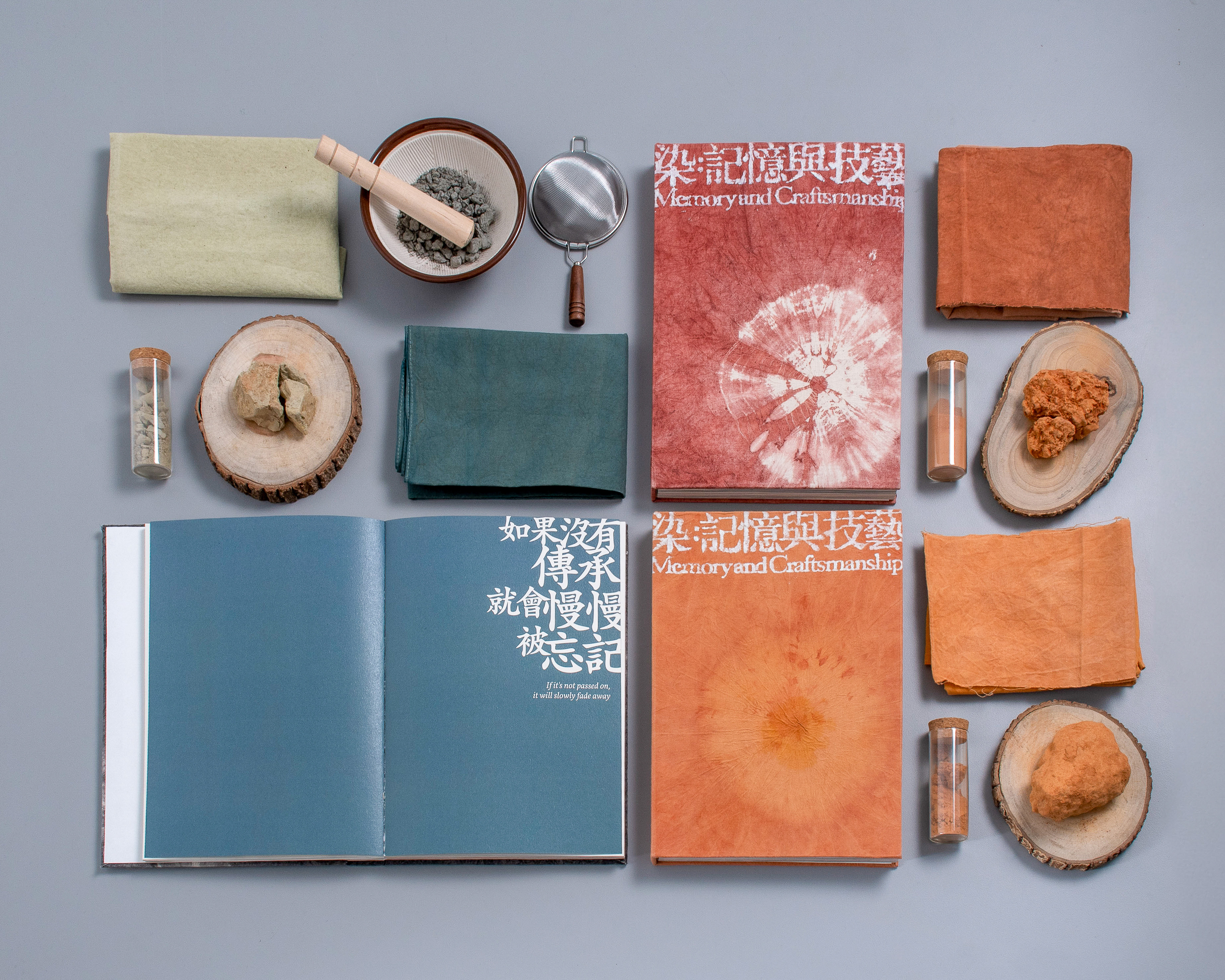
The book project Memory and Craftsmanship is centered on mud dyeing, showcasing the beauty of a natural dyeing technique that has gradually faded from memory as times have changed.
Chung-Wen Hsiao and Yi-Hui Lai shared that they entered the field of mud dyeing almost from scratch. From community colleges to master craftsmen’s studios, they repeatedly engaged in hands-on processes such as dyeing fabric, drying it, and unwrapping the results, witnessing the craft gradually take shape through exploration and uncertainty. Hsiao remarked, “This project allowed me to deeply appreciate the value of mud dyeing and its connection to the memory of the land, while also pushing me to grow through the unknown and ongoing challenges. I am especially grateful to Dr. Lun-Kuang Liao, Professor Wei-Yao Wang, and my advisor, Professor Tsu-Huai Yang, for making this work possible.” Lai added, “As a foreign student, being able to gain a deep understanding of Taiwanese culture through mud dyeing has been a rare and meaningful experience. It also pushed me beyond my original limits, and I am proud to have contributed to preserving this traditional craft.”
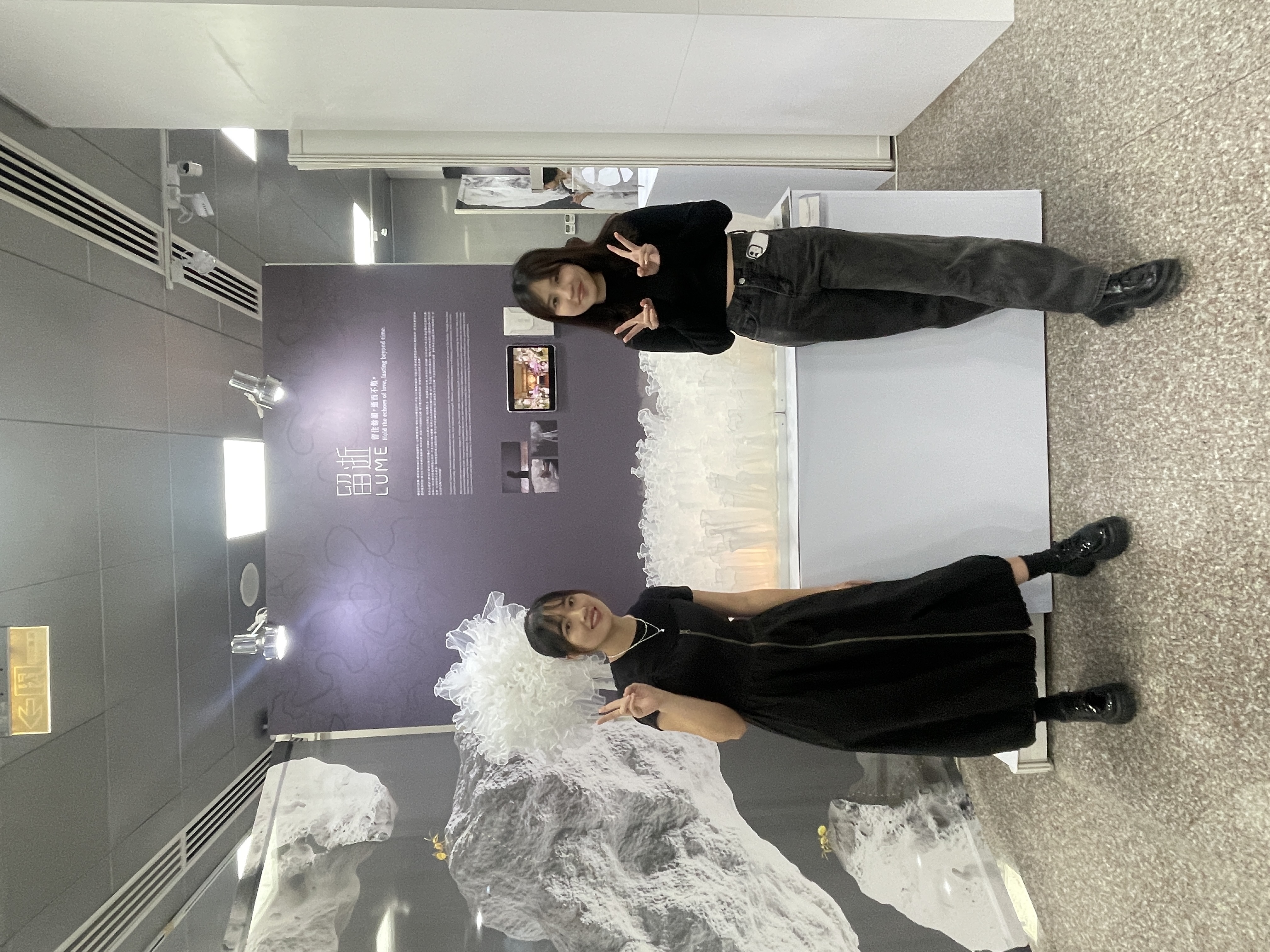
Under the guidance of Professors Hsien-Hui Tang, Hung Cheng, and Chung-Ping Lai, Taiwan Tech Department of Design students You-Hsi Liu (left) and Hung-Ling Chen (right) won a Red Dot Design Concept Award with their project Lume.
Created by Department of Design students You-Hsi Liu and Hung-Ling Chen under the guidance of Professors Hsien-Hui Tang, Hung Cheng, and Chung-Ping Lai, Lume takes the floral arrangements and wreaths commonly seen at funeral ceremonies as its design focus. By integrating lighting and modular floral elements, the project creates a reusable, immersive memorial setting that incorporates principles of sustainability. The work aims to move beyond the rigid conventions of traditional funerals, making rituals more personalized while using interactive floral design to extend the emotional connection between bereaved families and the departed.

The exhibition and installation work Lume, centered on sustainability and emotion, brings new possibilities to Taiwan’s funeral culture.
You-Hsi Liu and Hung-Ling Chen shared that during the interview process, they became deeply aware of society’s reluctance to address the topic of death, which further clarified the direction of their project. “From repeated material experiments to the final modular design, our goal was to make farewell rituals more emotionally resonant, reduce waste, and bring more possibilities to funeral practices,” they explained. They also expressed special thanks to funeral service providers, their advising professors, and interviewees for their support, noting that the award not only affirms their work but also encourages them to continue exploring themes of life, death, and sustainable design.

Currently a senior in the Department of Design at Taiwan Tech, Yi-Tsai Ding, under the guidance of Associate Professor Ken-Tsai Lee, connects the cultural heritage and distinctive features of Qingjing Farm from a holistic perspective.
Senior Department of Design student Yi-Tsai Ding, under the guidance of Associate Professor Ken-Tsai Lee, won a Red Dot Award in the Brand Identity / Brand Design category with his project Qing Jing Farm. Centered on the concept “finding the contours of home within an endless embrace,” the work redefined the brand positioning of Qingjing Farm. Through integrated visual design, packaging planning, and merchandise development, Ding reconnected the farm’s cultural history, sheep imagery, and family-oriented activities to create a brand experience rich in storytelling and warmth.
Ding shared that the project prompted him to rethink the essence of design—not merely as surface-level visual refinement, but as a process rooted in brand spirit that involves organizing and reconstructing content as a whole. He said, “It is a great honor to receive the Red Dot Design Award. The most meaningful aspect is not the award itself, but the recognition of everything I have accumulated along the way. This project feels like a medal marking my multidisciplinary explorations in university, and it has given me greater motivation and confidence for the future.”

Taiwan Tech Department of Design student Yi-Tsai Ding took Qingjing Farm as the subject of his project, establishing the brand spirit “finding the contours of home within an endless embrace.” Through visual identity and packaging design, the work connects Qingjing Farm’s cultural heritage with its natural imagery, earning recognition with a Red Dot Design Award.