
The 26th Graduation Exhibition of the Department of Design at Taiwan Tech officially opened today (May 7). Centered on the theme “Interface” and symbolized by the image of a “rope”, the exhibition reflects the constant tension and negotiation students experience between freedom and constraints throughout their graduation projects, ultimately weaving their own unique creative paths. This year’s exhibition features 61 projects that employ diverse design methodologies and interdisciplinary approaches to address issues such as environmental sustainability, disaster preparedness, cultural reflection, and animal welfare, demonstrating how design can serve as a means of responding to real-world challenges.
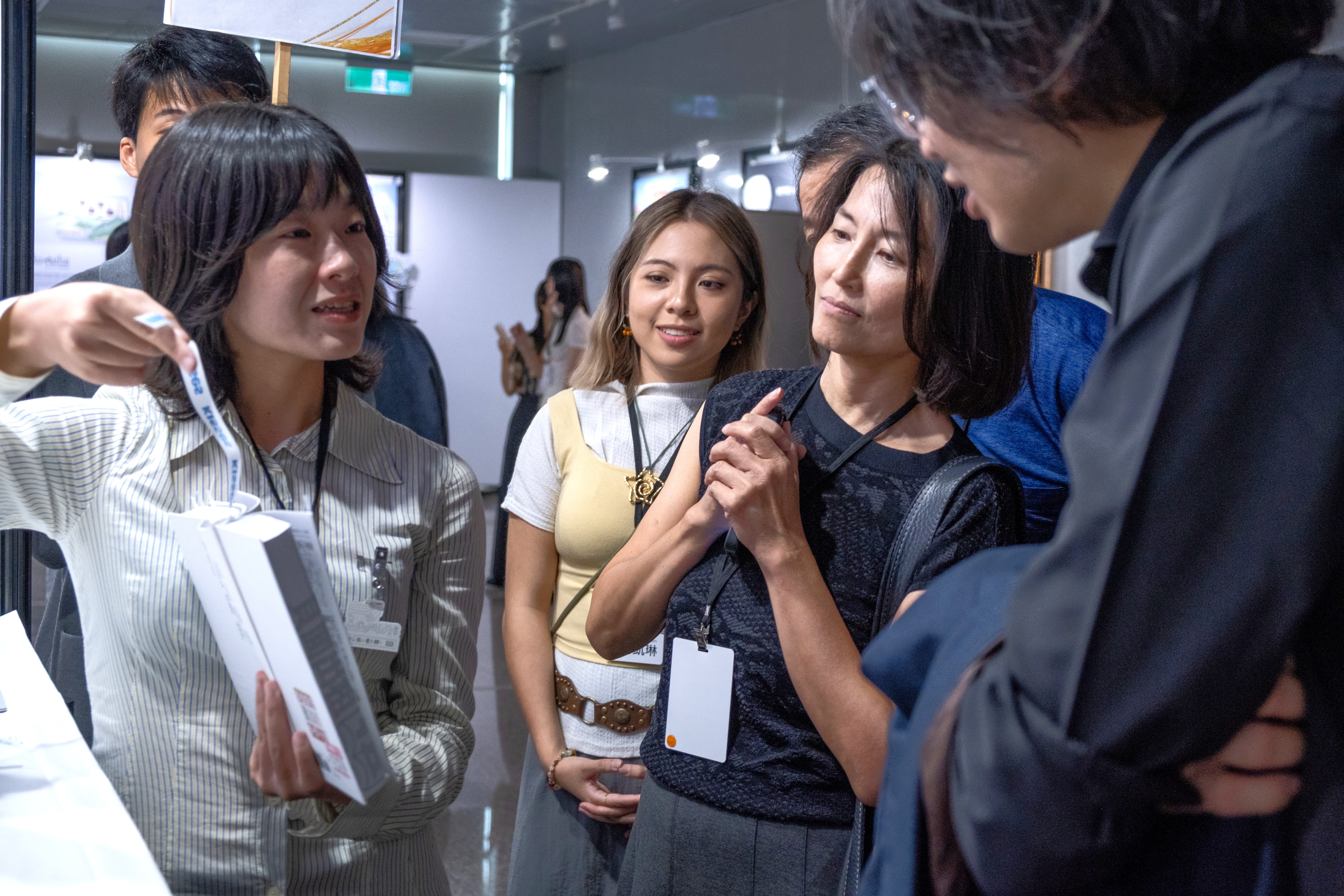
The 2026 Taiwan Tech Design Department Graduation Exhibition invites industry professionals and visitors from both within and outside the university to experience works that combine creativity with sustainable thinking.
Bringing together the culmination of four years of study, the exhibition encompasses industrial design, commercial design, and visual communication design, showcasing students’ abilities in design thinking, material application, and social observation. In his opening remarks, Taiwan Tech President Jia-Yush Yen stated that the university’s Department of Design ranks among the best not only in Taiwan but also in Europe. He noted that the exhibition theme, “Interface”, symbolizes the important role design plays as a bridge connecting people, technology, and society. President Yen further highlighted the rapid development of artificial intelligence and emphasized that Taiwan Tech’s College of Design has actively integrated AI into design education and practice. Rather than viewing AI as a replacement for designers, the university encourages students and faculty to leverage AI as a tool to enhance efficiency, expand creativity, and explore new possibilities in design.
Dean of the College of Design Ming-Huang Lin expressed gratitude to students and faculty advisors for their dedication throughout the creative process. Addressing the profound impact of AI on the humanities and social sciences, Dean Lin stressed that design should actively engage with other disciplines and develop closer collaborations with AI technologies to amplify its influence and value. He reaffirmed Taiwan Tech’s commitment to promoting AI-assisted design education and cultivating students’ abilities in interdisciplinary integration and innovative application.
One notable project, “RE-BOUNCE: Sustainable Court Bench”, created by Industrial Design students Fang-Yu Huang and Szu-Chin Lin, addresses the recycling challenges associated with sports balls, which are typically made from composite materials. In collaboration with industry partners, the team experimented with dismantling, shredding, and high-density compression techniques to transform discarded ball skins into a new eco-friendly material. The resulting modular bench not only optimizes seating and storage functions in sports facilities but also establishes a circular relationship of “from the court and back to the court.”
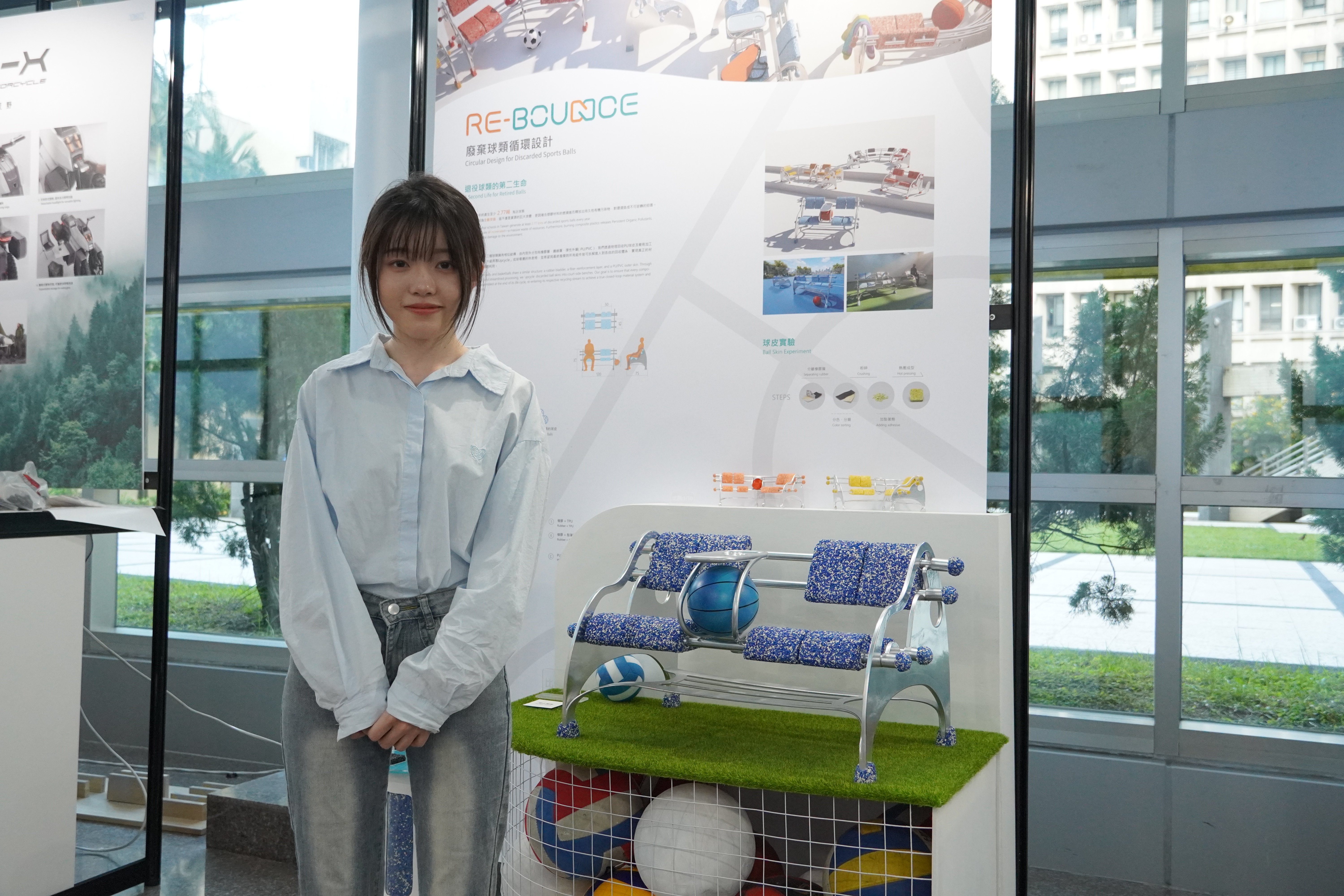
Industrial Design students Fang-Yu Huang and Szu-Chin Lin transformed 110 discarded ball skins into the modular seating system RE-BOUNCE, demonstrating ease of maintenance, durability, and a truly circular material lifecycle.
Another project inspired by everyday life and disaster preparedness is “FLIP Protective Headrest Stool”, designed by Chin-Hao Lin and Hsu-Tung Yuan. Responding to Taiwan’s frequent earthquakes and limited living spaces, the project functions as a minimalist stool that can be flipped and transformed into protective head and neck gear during emergencies. The exterior incorporates a ribbed wave structure to disperse impact forces, while the interior uses TPU honeycomb material to improve cushioning and ventilation. The design also includes photoluminescent features for visibility during power outages. Lin explained that the greatest challenge was balancing the dual requirements of furniture and protective equipment. Extensive testing and refinement were necessary to achieve both seating stability and user safety. Through the project, the designers hope to encourage greater public awareness of integrating disaster preparedness into everyday life.
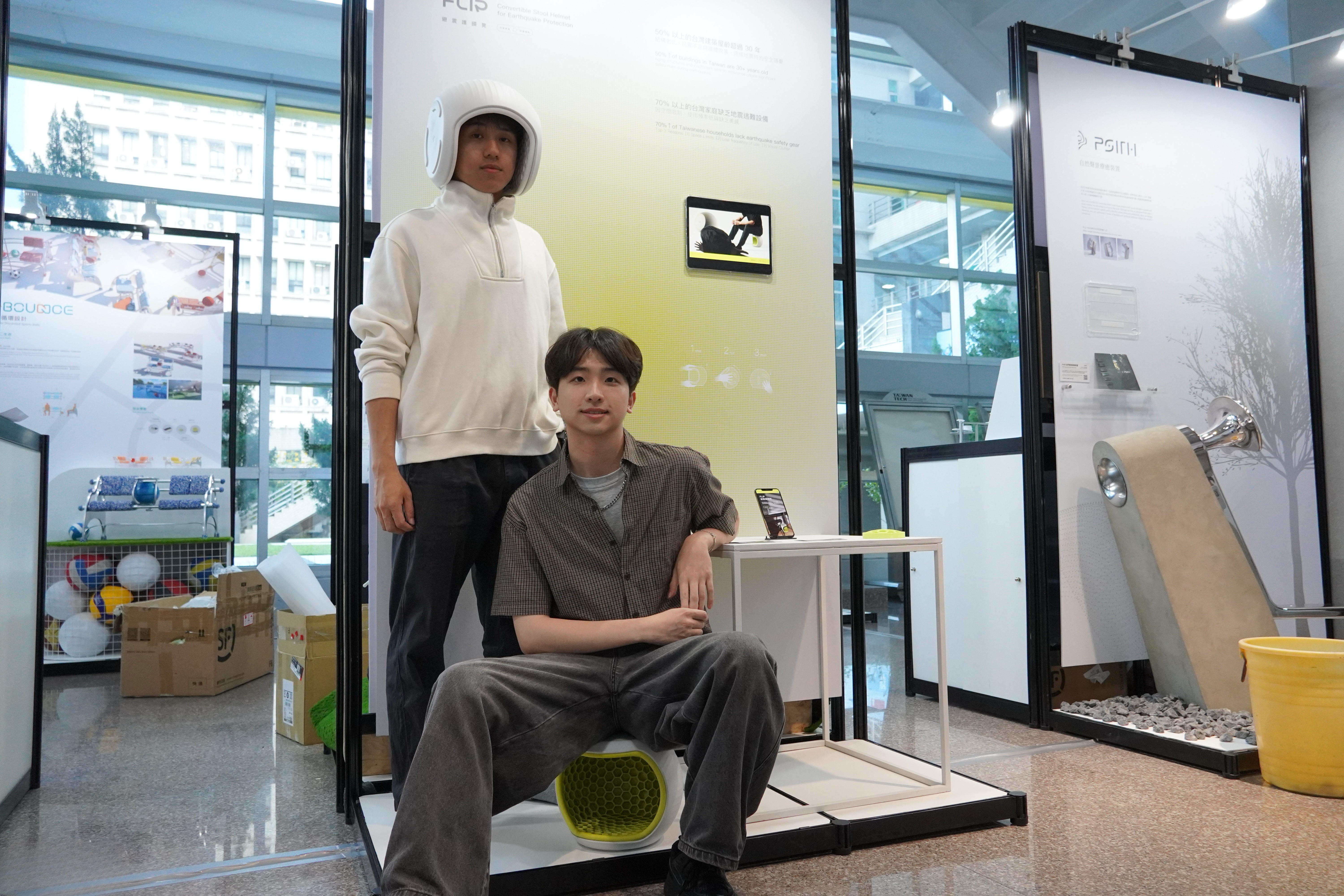
Chin-Hao Lin (right) and Hsu-Tung Yuan (left) developed the FLIP Protective Headrest Stool to raise awareness of the importance of personal disaster-preparedness equipment.
Beyond addressing practical social needs, several projects explore conceptual and cultural issues. “NeoLuck Studio”, created by Hao-Jan Ching and Ya-Yun Cheng, adopts a speculative design approach to examine superstition in workplace culture. Observing various unwritten rules and superstitious practices in office environments, the designers developed technological artifacts that materialize concepts of “luck,” such as devices that identify the office’s daily wealth corner or calculators that evaluate the fortune associated with numbers. According to Ching, unlike traditional product design focused on solving problems, NeoLuck Studio aims to provoke discussion and reflection. Through absurd and contradictory interactions, the project encourages viewers to reconsider the role of superstition in contemporary life.
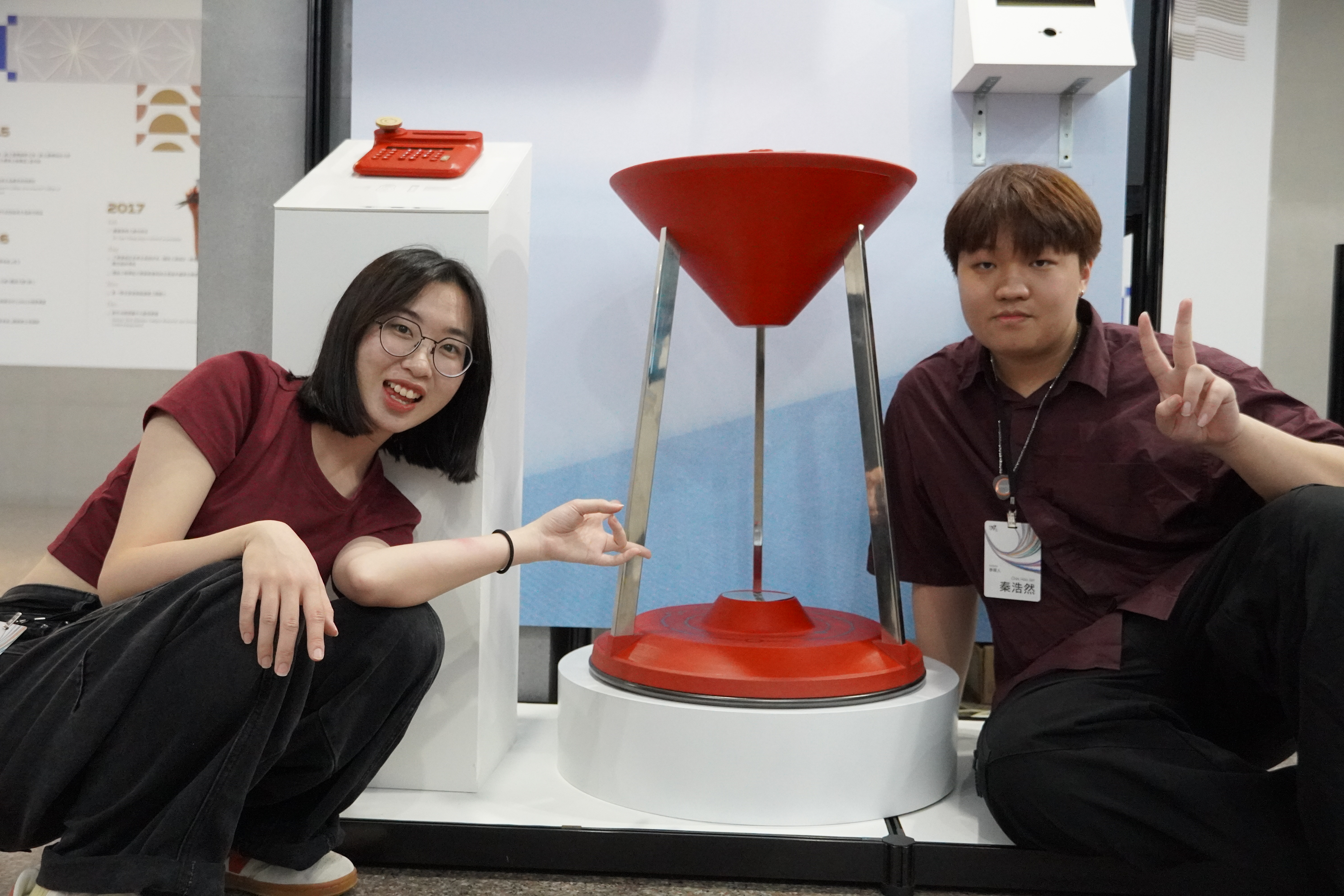
Ya-Yun Cheng (left) and Hao-Jan Ching (right) challenge conventional product-design expectations through NeoLuck Studio, using unconventional interactions and playful absurdity to prompt reflection on deeply rooted superstitions in everyday life.
In the field of visual communication design, Chien-Hsin Ou and Yu-Ni Chen transformed the word “Attention” into “Adtention” through their project “Pay Adtention!: Promotional Edition Mandarin Dictionary”. Designed primarily for elementary school students who have not yet fully developed information-filtering abilities, the project highlights the influence of commercial interests on language and knowledge. To make the concept tangible, the team invited real brands to collaborate, incorporating advertisements directly into dictionary content. Through visual disruptions and reconstructed meanings, the project challenges viewers to consider whether independent judgment remains possible in an era where the boundaries between information and advertising are increasingly blurred. The designers noted that producing the project required them to navigate simultaneously as designers, advertisers, and critics while managing communication challenges and time constraints. The experience ultimately provided valuable insight into the realities of the creative industry.
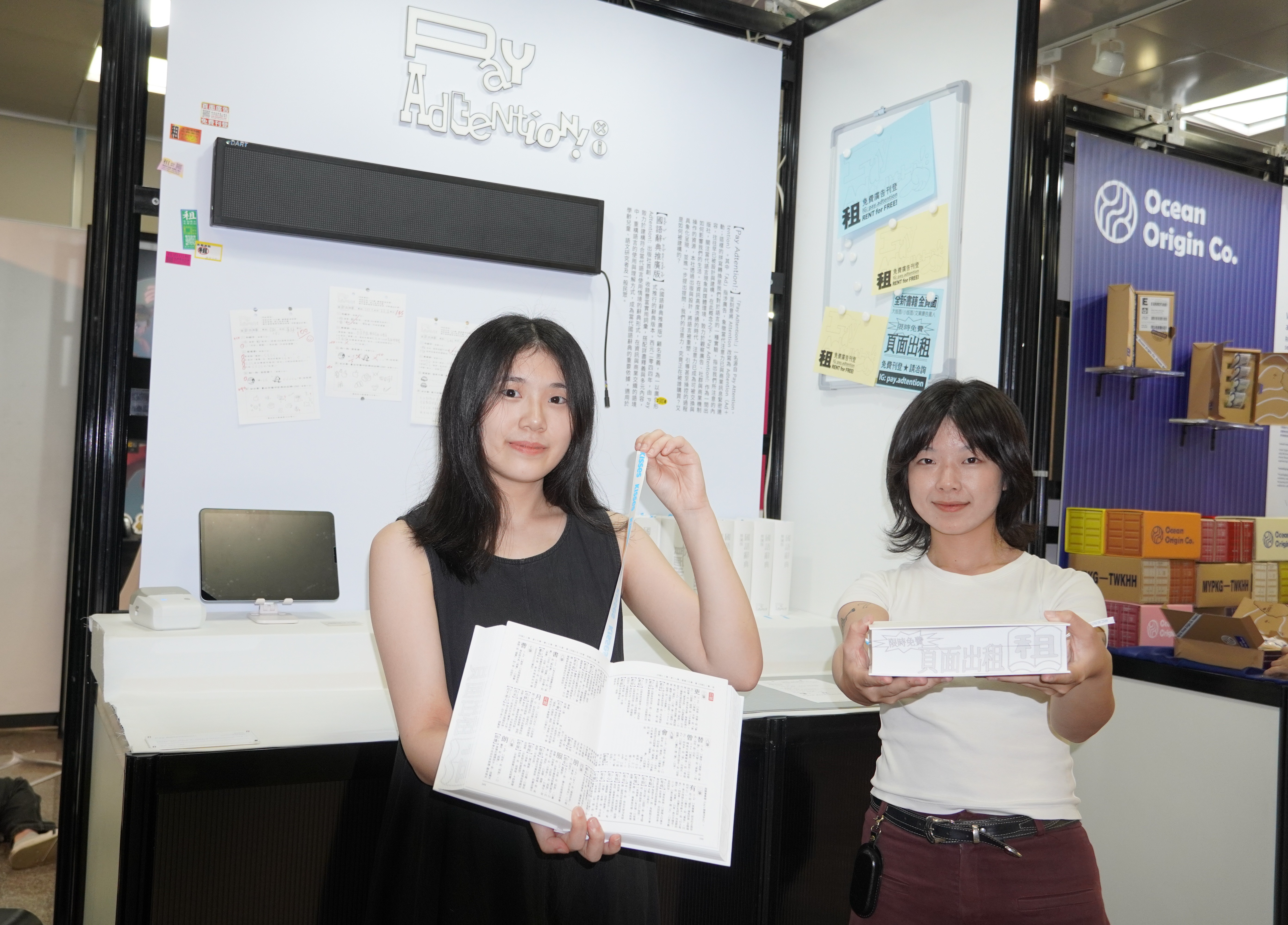
Chien-Hsin Ou (left) and Yu-Ni Chen (right) explore the relationship between language and commerce in Pay Adtention!: Promotional Edition Mandarin Dictionary, examining how advertising influences reading and cognition.
The exhibition is organized across three major exhibition spaces, guiding visitors through a diverse range of design proposals that reflect students’ responses to contemporary issues. Additional projects, including “SHIELDEX Metro Carriage Emergency Defense Shield System”, “Rolloo Children’s Storage Play Cart”, “Breathing Point”, and “The MARK”, have also been shortlisted for the Golden Pin Design Award – Young Designers’ Exhibition. From material regeneration and multifunctional product design to speculative design and cultural critique, the exhibition demonstrates that design is not only a tool for problem-solving but also a means through which students interpret the world and articulate their perspectives. Through both on-campus and external exhibitions, these projects will continue engaging with audiences and industry professionals, gaining valuable feedback that will inform future development and design practice.
For more information, please visit the 2026 NTUST Design Department Graduation Exhibition Facebook page or Instagram account.
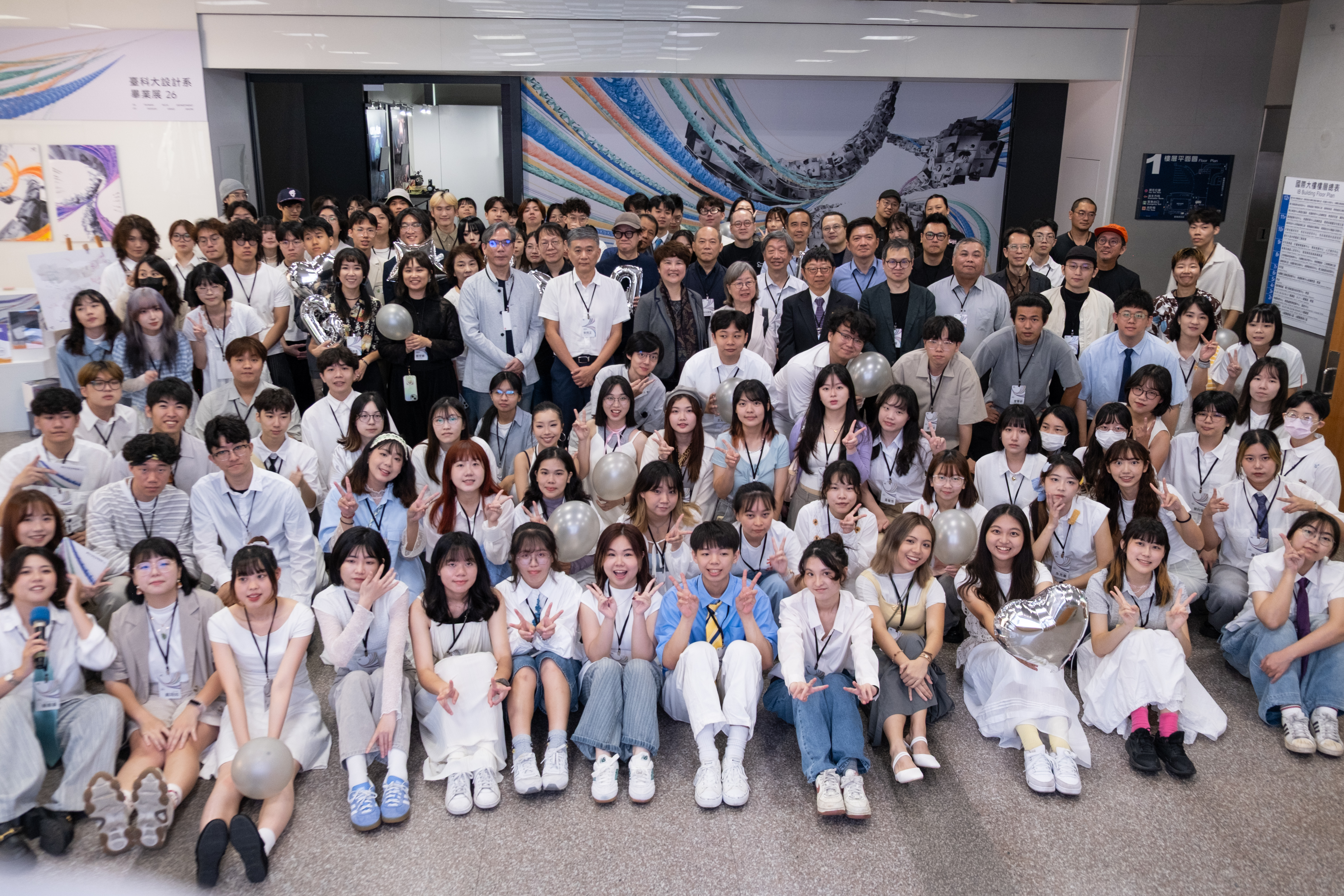
The 2026 Taiwan Tech Design Department graduating class took a group photo.
Exhibition Period: May 7–11, 2026
Opening Hours: 10:00 a.m.–6:00 p.m. (May 11 open until 12:00 p.m.)
Venue:
IB International Building 1F Corridor, Taiwan Tech Art Gallery, and Dayong Workshop, Taiwan Tech
Exhibition Period: May 22–25, 2026
Opening Hours: 10:00 a.m.–5:00 p.m. (until 6:00 p.m. on weekends)
Venue:
TaiNEX 2 (Taipei Nangang Exhibition Center, Hall 2)
1F, No. 2, Jingmao 2nd Road, Nangang District, Taipei City, Taiwan.