
Taiwan Tech's Center for Teacher Education has long been committed to advancing technology education and teacher professional development while actively promoting AI education at the K–12 level. This year, in collaboration with the National Science and Technology Council (NSTC), National Taipei University of Technology, National Chengchi University, and Taipei Medical University, the Center co-organized the 2nd “AI for a Better Future” National Senior High School and Vocational High School Artificial Intelligence Innovation Application Competition. A total of 12 outstanding teams from across Taiwan advanced to the finals, where students applied AI technologies to address issues such as fraud prevention, healthcare, smart education, and public safety, demonstrating how AI education can be integrated with meaningful social practice.
The competition originated from the “AI for Good – Artificial Intelligence Popularization Program for Senior High School and Vocational High School Students”, which aims to reduce disparities in educational resources between urban and rural areas as well as among schools, ensuring that students nationwide have opportunities to access, learn, and apply AI technologies. In alignment with the United Nations Sustainable Development Goals (SDGs), particularly Quality Education (SDG 4), Industry, Innovation and Infrastructure (SDG 9), and Reduced Inequalities (SDG 10), Taiwan Tech's Center for Teacher Education leverages the University's academic expertise and educational resources to help teachers and students develop AI literacy, enabling AI education to become an integral part of school education and a practical tool for addressing real-world social challenges.
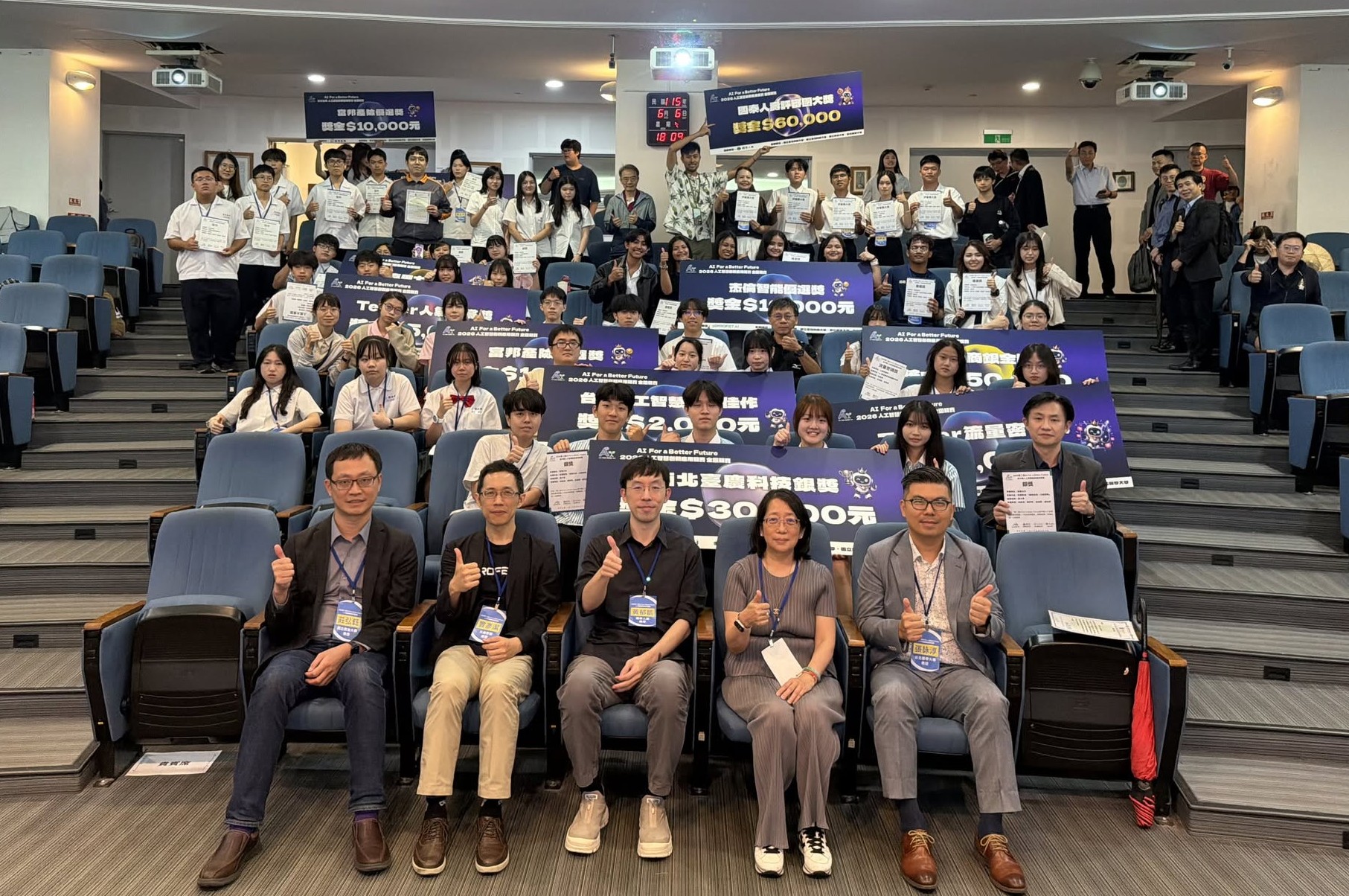
The 2nd “AI for a Better Future” National Senior High School and Vocational High School Artificial Intelligence Innovation Application Competition concluded successfully recently.
Beginning in October 2025, the project collaborated with Taiwan Tech's Center for Teacher Education to organize the “AI Seed Teacher Training Camp”, prioritizing the development of AI competencies among senior high school and vocational high school teachers. The program equipped teachers with AI tools, curriculum design strategies, and practical teaching methodologies. After returning to their schools, participating teachers guided their students through the “AI for Good” workshops, where students gradually developed foundational AI skills, problem analysis abilities, and project-based learning experience before ultimately entering the competition. This created a sustainable AI education model that transformed creative ideas into practical AI applications.
Professor Cathy Weng of Taiwan Tech's Center for Teacher Education stated that the greatest value of the competition lies not only in showcasing student achievements but also in establishing a sustainable educational model. Through the complete process of “training teachers, empowering students, deepening hands-on practice, and participating in competitions”, teachers become key ambassadors for AI education, while students progressively develop an understanding of AI principles and skills and learn how to apply technology to address societal needs.
The competition entries demonstrated students' ability to combine technological innovation with social responsibility. The Jury Grand Prize, sponsored by Cathay Life Insurance, was awarded to Chao-Chou Senior High School in Pingtung County for its project “AI Fraud Detection Laboratory”, which uses artificial intelligence to identify potential fraud risks in response to the growing problem of scams in society. The Gold Award, sponsored by The Shanghai Commercial & Savings Bank Ltd., went to Taipei Municipal Da-An Vocational High School for its project “Egg Wish You Good Health”, which focuses on health management. The Silver Award, sponsored by Tai-Tech, was presented to New Taipei San-Chung Commercial and Industrial Vocational High School for developing “Socrates: Pocket Tutor”, a personalized learning assistant powered by generative AI. National Keelung Municipal Commercial and Industrial Vocational High School received the Bronze Award, sponsored by Kerry TJ Logistics, for its “AI Image Recognition Alarm System” which applies image recognition technology to enhance public safety and warning capabilities.
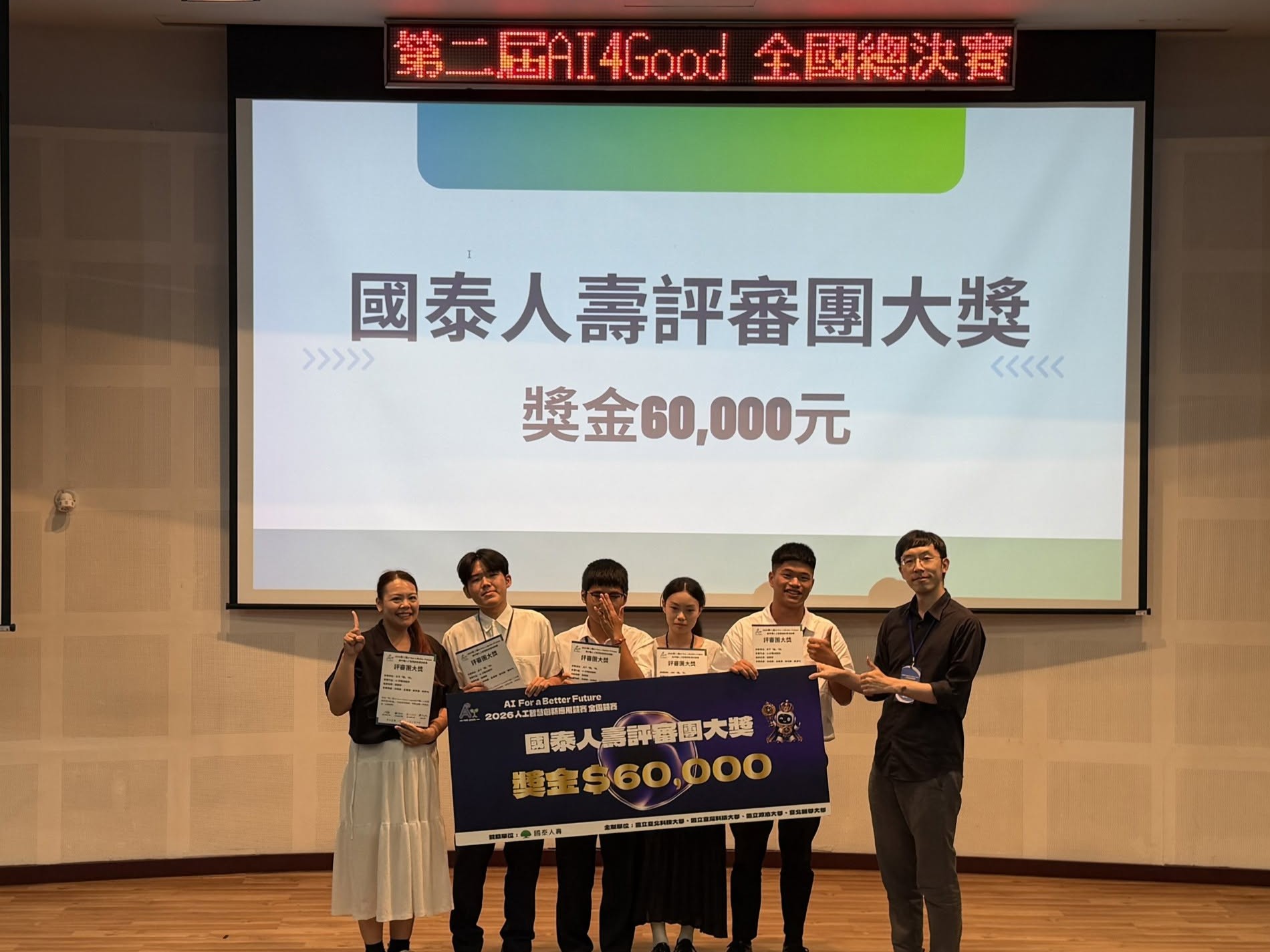
Chao-Chou Senior High School in Pingtung County won the Cathay Life Insurance Jury Grand Prize with its project “AI Fraud Detection Laboratory”, receiving a cash prize of NT$60,000.
Professor Weng noted that the award-winning projects reflected senior high school and vocational high school students' keen awareness of social issues and their strong sense of social responsibility. Whether addressing fraud prevention, health promotion, educational innovation, or public safety, the students moved beyond simply demonstrating technical skills to exploring how AI can be meaningfully applied to solve real-world problems and create social value. This, she emphasized, represents the fundamental goal of AI education - not only cultivating technical talent, but nurturing a new generation of citizens who can use technology responsibly to improve society.
This year's competition invited experts from both academia and industry to serve as judges. Projects were evaluated comprehensively based on innovation, practicality, technical feasibility, social impact, and presentation quality. The judges also provided detailed feedback and recommendations to help participating teams further refine their projects and guide their future development.
Professor Weng further emphasized that the key to promoting AI education lies in empowering teachers. Only by equipping frontline educators with AI literacy and the ability to integrate AI into their teaching can more students naturally encounter, understand, and effectively apply AI in their daily learning. Looking ahead, Taiwan Tech's Center for Teacher Education will continue to integrate the resources of universities, industry partners, and senior high schools and vocational high schools to expand AI Seed Teacher Training, student hands-on workshops, and inter-school exchange programmes. By extending AI education beyond competitions and into everyday classrooms, the Center aims to transform individual successes into a widespread educational movement, cultivating future talents who possess technological competence, social responsibility, and innovative problem-solving abilities, and who can harness AI to build a better future for society.