
As countries around the world actively pursue net-zero carbon emissions, microalgae have emerged as a promising green technology due to their highly efficient photosynthesis and potential applications in bioenergy. A research team led by Distinguished Professor Yu-Lin Kuo of the Department of Mechanical Engineering at Taiwan Tech has combined plasma-activated water and microalgae cultivation technologies to explore green carbon sequestration methods. Team member Po-Hsiang Chang successfully demonstrated that, under specific conditions, Plasma-Activated Water (PAW) can effectively promote the growth of freshwater green microalgae (Chlorella vulgaris) and significantly improve carbon fixation efficiency. The team has also proposed the concept of a “Sustainable Microalgal Carbon Fixation Platform”. providing a new direction for future low-carbon circular technologies and biological carbon capture.
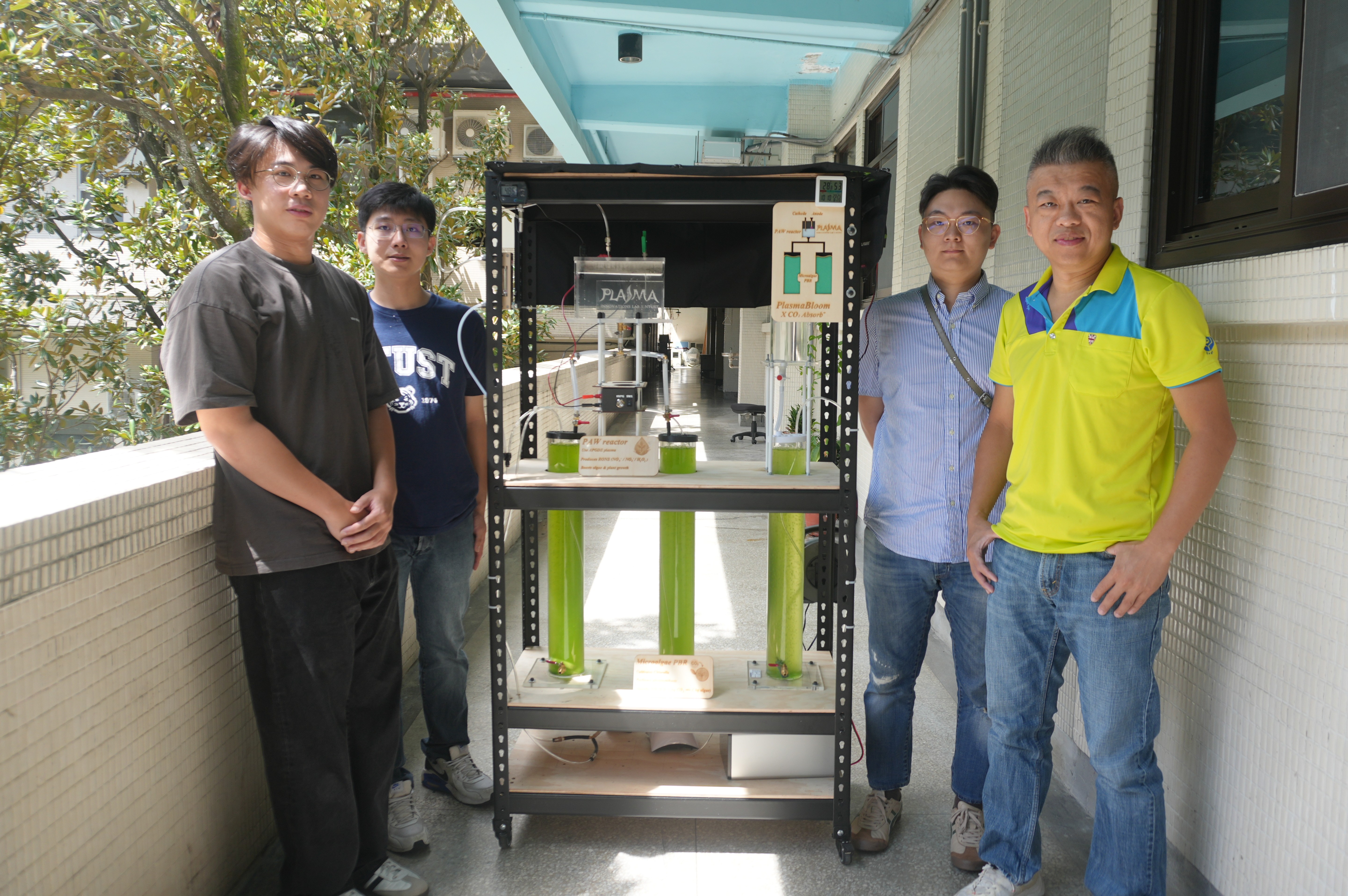
The research team led by Distinguished Professor Yu-Lin Kuo of Taiwan Tech’s Department of Mechanical Engineering has developed a “Sustainable Microalgal Carbon Fixation Platform”, providing a new direction for future low-carbon circular technologies and biological carbon capture. From left: team members Po-Hsiang Chang, Po-Hsun Huang, Ping-Wei Lin, and Distinguished Professor Yu-Lin Kuo of the Department of Mechanical Engineering.
In addition to effectively fixing carbon dioxide, microalgae can be converted into a variety of high-value products. For example, algal lipids can be converted into biodiesel, carbohydrates can be used to produce bioethanol, and certain algal pigments and proteins can be used in dietary supplements, animal feed, and green materials. Compared with conventional carbon capture technologies, such as geological sequestration, chemical absorption, and physical adsorption, microalgal carbon fixation offers advantages including low energy consumption, low pollution, and high potential for resource recovery. It therefore has the potential to become an important solution for advancing a low-carbon circular economy in the future.
Po-Hsiang Chang developed a strong interest in carbon reduction issues while studying Environmental Engineering as an undergraduate. After entering graduate school, he was introduced to the laboratory’s existing plasma water treatment technology. While discussing potential research directions with his professor, he realized that microalgae themselves are highly efficient organisms for carbon fixation. He noted that previous international studies had indicated that reactive oxygen and nitrogen species (RONS) contained in Plasma-Activated Water, such as nitrate and nitrite ions, could promote microalgal growth. He therefore decided to integrate the two technologies and attempt to develop a sustainable technology that “does not require chemical fertilizers while improving carbon fixation efficiency”.
Chang combined atmospheric-pressure, room-temperature plasma technology with a microalgae cultivation system to investigate the effects of PAW prepared under different conditions on the growth and carbon fixation efficiency of freshwater Chlorella vulgaris. The research included analyzing reactive species and gases using optical emission spectroscopy (OES), as well as measuring the concentrations of nitrate (NO₃⁻), nitrite (NO₂⁻), and hydrogen peroxide (H₂O₂) in the water. Different PAW samples were then applied to Chlorella vulgaris cultures to observe changes in absorbance, dry weight, growth rate, biomass, and carbon dioxide fixation efficiency.
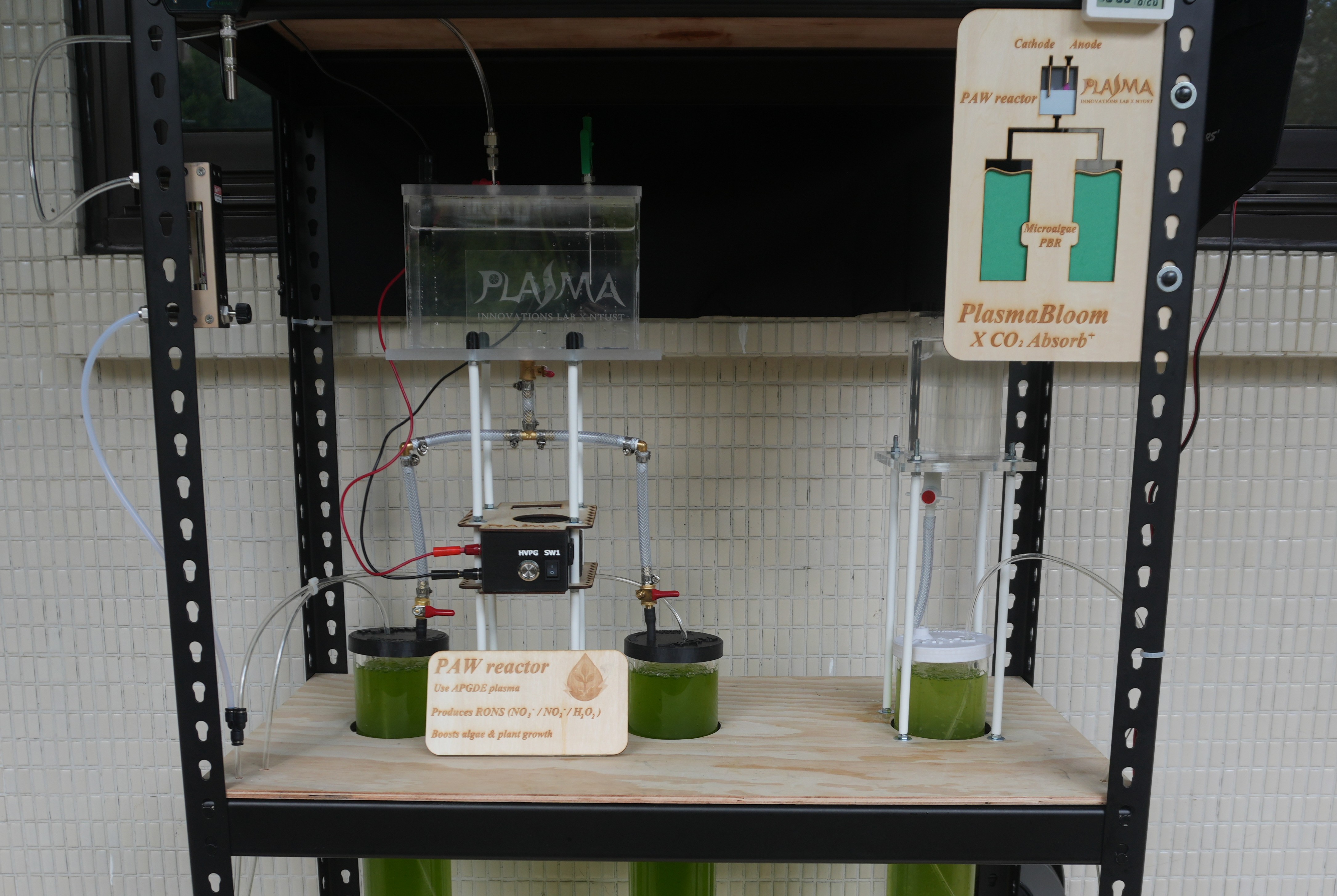
Po-Hsiang Chang, together with Po-Hsun Huang and Ping-Wei Lin, developed a Plasma-Activated Water Generation System (APGDE) to investigate the effects of PAW prepared under different conditions on the growth and carbon fixation efficiency of freshwater Chlorella vulgaris.
The results showed that PAW prepared under conditions of 70 W atmospheric-pressure glow discharge plasma (APGDE) with an Anode Air discharge for five minutes produced the strongest growth-promoting effect on Chlorella vulgaris. Carbon fixation efficiency increased by approximately 63% compared with the control group. Chang explained that the key feature of PAW is that it contains nitrogen sources that microalgae can directly absorb and utilize. “It is essentially like turning water into fertilizer”. Moreover, these nutrients are not generated through the addition of chemicals; instead, they are produced directly in the water by plasma. This approach can therefore reduce environmental impacts and help decrease the use of conventional chemical fertilizers.
In addition to demonstrating the feasibility of using PAW to improve carbon fixation efficiency, Chang also proposed the concept of a “Sustainable Microalgal Carbon Fixation Platform”, developing a modular, mobile, and scalable low-carbon system. The platform consists primarily of four components: a PAW generation system, a microalgal photosynthetic airlift bioreactor, an air supply system, and a solar power module. PAW provides nutrients for microalgae, which absorb CO₂ and grow before being converted into high-value products, creating a circular carbon utilization framework. Compared with conventional microalgae cultivation methods, this technology combines environmental benefits with cost-saving potential. If further scaled up in the future, it could become a new cultivation model that integrates carbon reduction with the circular economy.
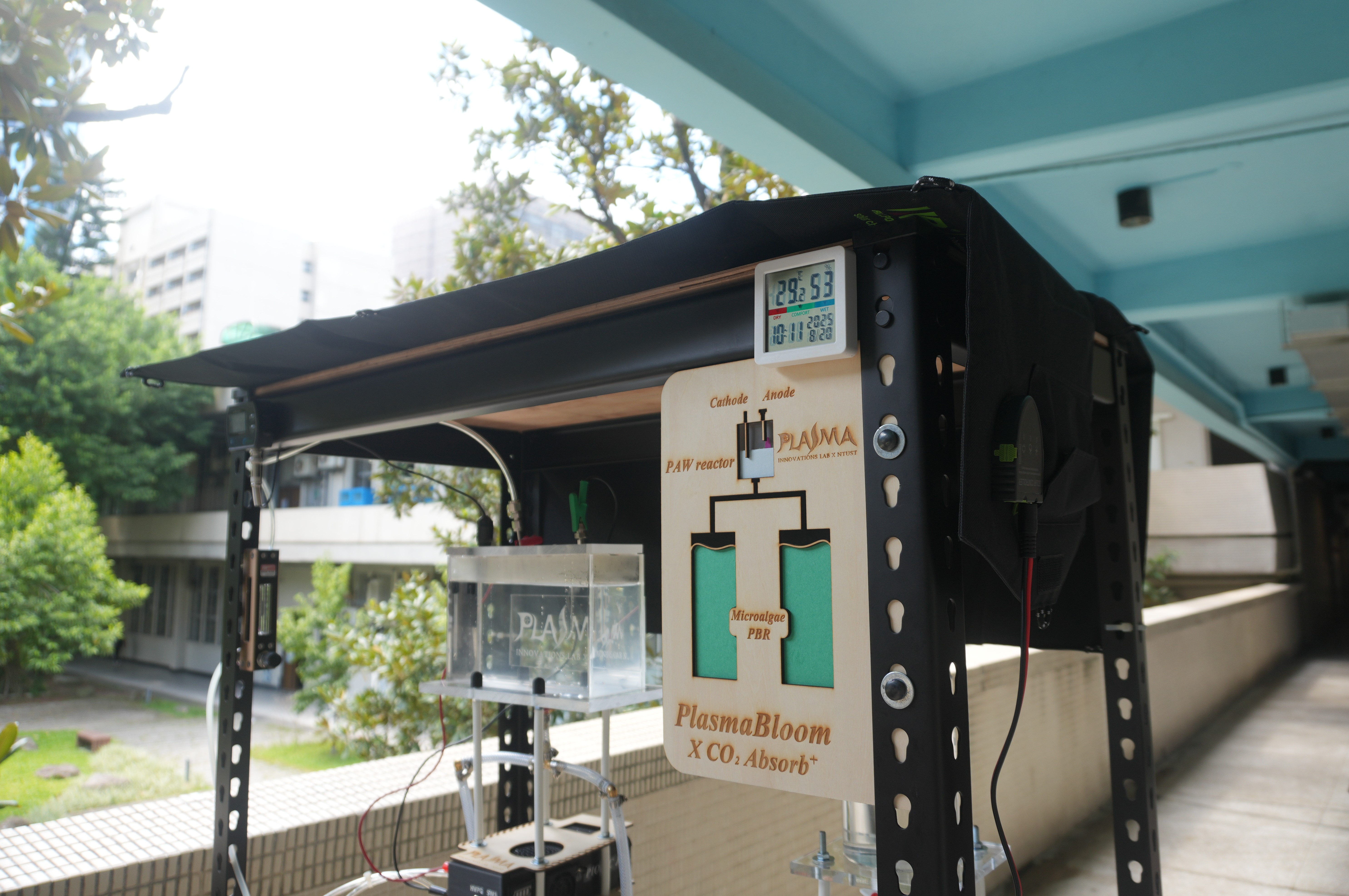
A solar power module is installed above the system to reduce energy consumption and create a circular carbon utilization framework.
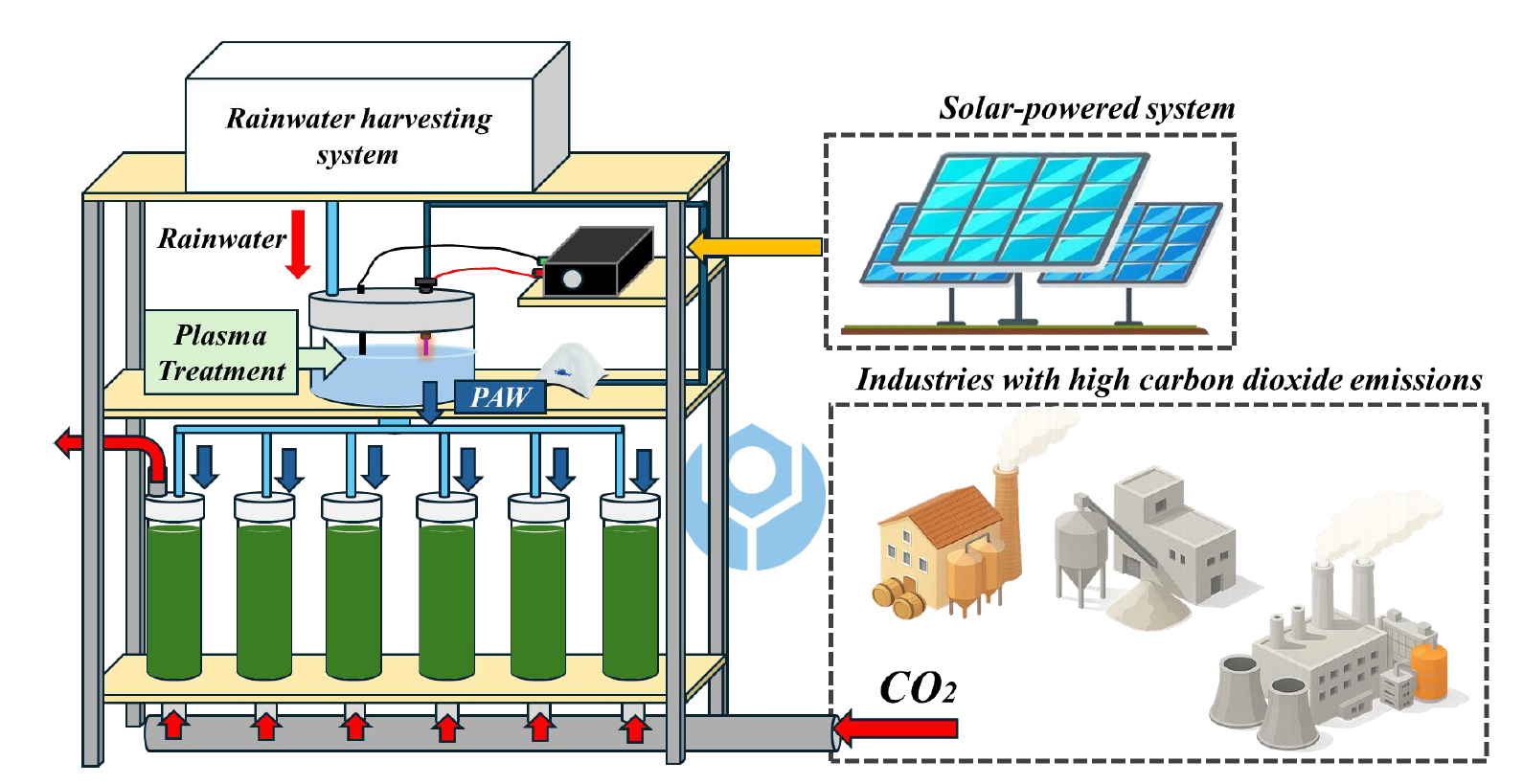
Conceptual design of a microalgal bioreactor for applications simulating industrial carbon dioxide emissions.
The team has currently completed preliminary prototypes of a 3.5-liter photobioreactor and a portable PAW generator, which can be adjusted according to the requirements of different application sites. In the future, the team hopes to gradually scale up the system and integrate it with high-carbon-emitting industries, such as thermal power plants, cement plants, and breweries. Purified carbon dioxide from industrial emissions could be directly introduced into microalgal bioreactors, creating a circular model of “local carbon capture and local utilization”. At the same time, the team plans to integrate solar panels and rainwater collection systems to establish a self-sufficient microalgal carbon fixation platform while reducing energy and water consumption.
Chang said, “Sustainability is not an issue that we can wait ten years to address; we have to act now”. He believes that the greatest advantage of young researchers is their willingness to experiment with new approaches without being constrained by existing frameworks. He also hopes that more industries will adopt microalgal carbon capture technologies in the future and potentially reduce their use of chemical fertilizers, so that carbon reduction is not merely a slogan but a concrete action that can truly be implemented in everyday life and industrial applications.