
To encourage students to broaden their international perspectives and participate in hands-on exchanges on cutting-edge technologies, the College of Electrical Engineering and Computer Science at Taiwan Tech collaborated with the Beyond-G Global Innovation Center of Hanyang University in South Korea to organize the three-day “From O-RAN to AI-RAN: Practical 6G RAN Experimentation” workshop from June 22 to 24. Students traveled to South Korea to participate in English-medium courses and hands-on experiments focusing on emerging technologies, including Open Radio Access Network (O-RAN), AI-RAN, Digital Twin, and 6G wireless communications. Through international exchange and practical training, the workshop aimed to equip students with the capabilities needed to engage with international research and development.
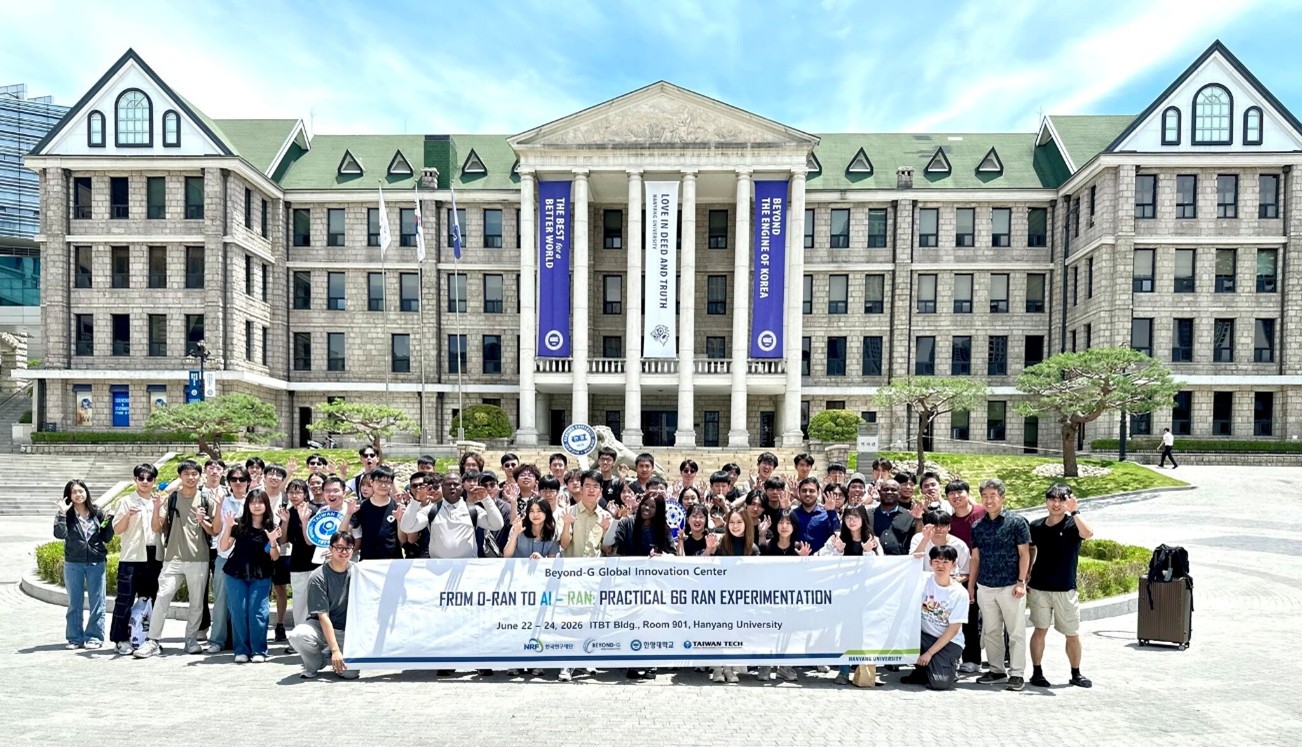
Taiwan Tech students visit Hanyang University in South Korea to participate in the 6G RAN practical workshop and take a group photo with faculty members from the 6G Center.
The workshop attracted nearly 80 students from four departments and programs in the College of Electrical Engineering and Computer Science, including the Department of Computer Science and Information Engineering, the Department of Electronic and Computer Engineering, the Department of Electrical Engineering, and the International Program in Information and Communication Technology. Following a selection process based on application materials and an English-language interview, 50 students were admitted to the workshop. They were divided into beginner and advanced groups according to their academic backgrounds. Over the three-day program, students progressed from fundamental concepts of mobile networks and O-RAN to O-RAN software components, Digital Twin scenarios, and AI-RAN optimization applications. Through hands-on exercises, students completed environment deployment, xApp development, and system validation, transforming classroom knowledge into practical experience.
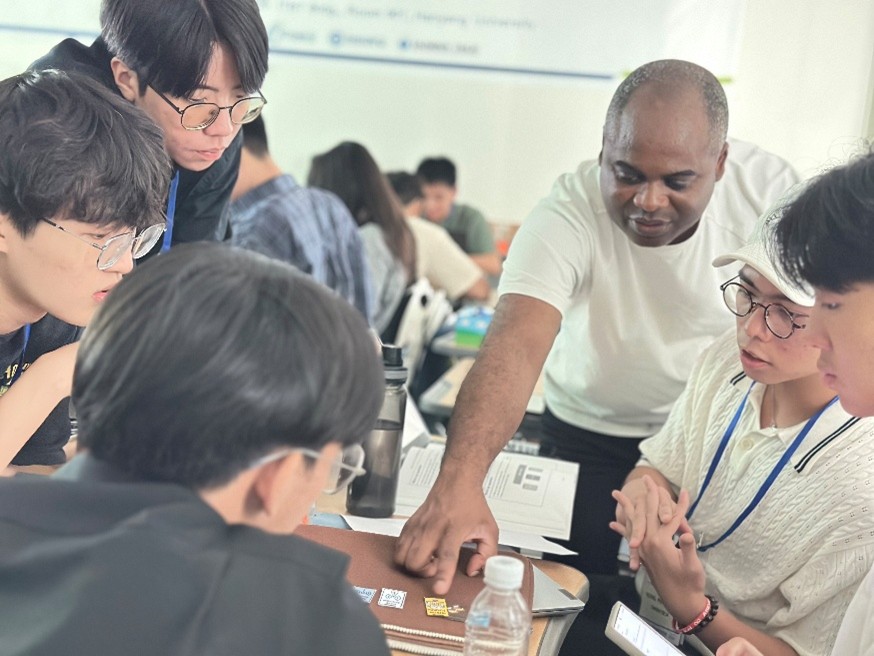
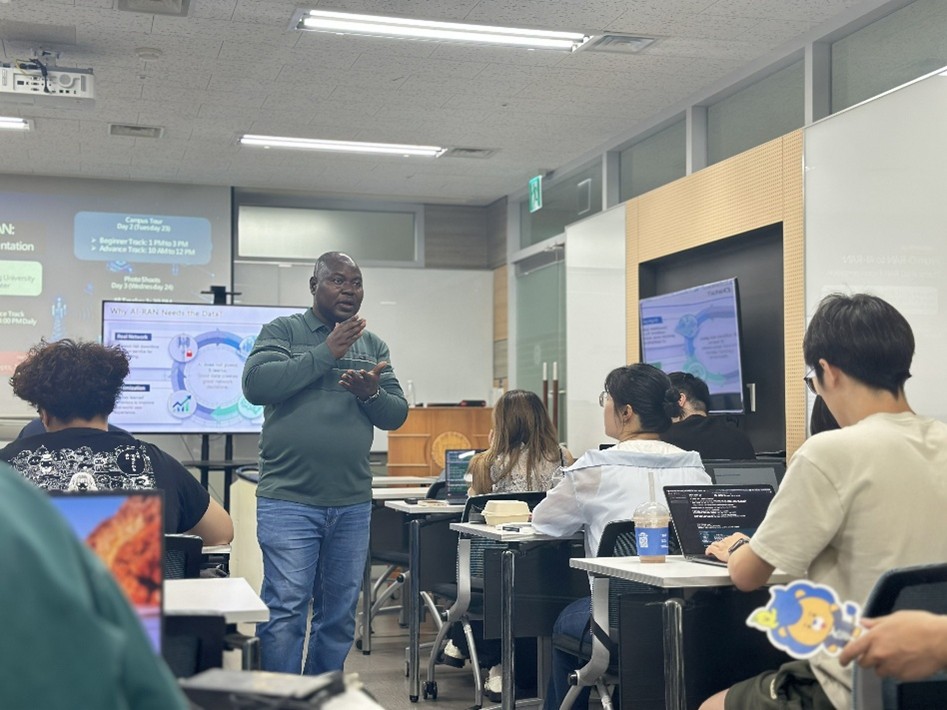
The workshop was conducted entirely in English, with instructors guiding students through learning and hands-on practice in 6G RAN-related technologies.
Yuan-Yin Liu, a student in the Department of Computer Science and Information Engineering, shared that he had always looked forward to opportunities to step beyond the campus and broaden his international perspective, and therefore greatly valued the opportunity to participate in the exchange program in South Korea. In addition to learning about emerging communications technologies such as O-RAN and AI-RAN, he was particularly impressed by his visit to the laboratories at Hanyang University. Seeing Digital Twin technology being applied to radar detection firsthand gave him a much more concrete understanding of related research.
Yuan-Yin Liu also noted that this was his first time independently planning an overseas trip. From arranging flights and accommodation to adapting to a different learning environment, the experience presented valuable challenges and opportunities for personal growth. “It was really impressive to see Digital Twin technology actually being applied to radar detection. This workshop was highly rewarding for me, both in terms of professional knowledge and travel planning”.
Pei-Tun Hong, a student in the Department of Electronic and Computer Engineering, said that he had just taken the course “Signals and Systems” during the semester and was therefore particularly curious about how O-RAN could be integrated with AI technology and how the entire system operates in practice. Compared with theoretical derivations in the classroom, he found that being able to operate the system himself and understand how it is deployed and run helped deepen his learning. The three-day course was intensive, covering environment deployment, xApp programming, and simulations using Digital Twin technology, with students required to complete each experiment themselves.
What impressed him most was successfully completing the entire process in the terminal, from platform setup and radio simulation to xApp deployment. Although he did not fully understand all the system messages at the time, he gradually came to understand the underlying technical logic by consulting reference materials and using AI tools for assistance. This allowed him to truly experience how classroom knowledge can be applied in real-world contexts. “At that moment, I suddenly realized that the knowledge we learn in class is no longer just a set of formulas on an exam paper. Somewhere else, people are actually using these technologies to develop all kinds of innovative applications”, Pei-Tun Hong said. He added that the overseas training not only strengthened his technical skills but also rekindled the passion that originally led him to choose electronic engineering.
Sung-Hao Yeh, a student in the International Program in Information and Communication Technology, said that he had high expectations for the exchange because the workshop’s themes closely matched his research interests and South Korea has achieved a relatively advanced level of development in communications technology. Exposure to emerging technologies such as O-RAN, AI-RAN, and Digital Twin not only expanded his professional knowledge but also enhanced his cross-cultural communication and professional presentation skills through English-medium instruction and interaction with international faculty members and students.
Sung-Hao Yeh believes that Digital Twin technology can simulate real-world scenarios in a virtual environment and then conduct experimental validation, allowing him to see the diverse application possibilities of future communications technologies. “This activity not only enhanced my professional knowledge but also broadened my international perspective. For me, it was an extremely valuable learning experience”.
Professor Jenq-Shiou Leu, Dean of the College of Electrical Engineering and Computer Science at Taiwan Tech, said that the workshop’s greatest achievement was enabling students to see the bridge between theory and practice. Starting from the fundamentals of RAN, students went on to explore the open architecture of O-RAN, software-based experimentation, Digital Twin data generation, and AI-RAN optimization applications. Through hands-on experiments and scenario-based exercises, they gained an understanding of the key technologies required for future 6G research.
Professor Jenq-Shiou Leu pointed out that the event also aligned with the spirit of the Ministry of Education’s Bilingual Learning Program and demonstrated Taiwan Tech’s continued efforts in promoting hands-on education and internationalized learning. By extending the university’s English as a Medium of Instruction (EMI) learning environment to an international setting through English-medium professional courses, overseas practical training, and international exchange, the program helps students develop the ability to communicate professionally in English, collaborate in teams, and participate in international research communities, putting EMI education into practice beyond the classroom and on the international stage.
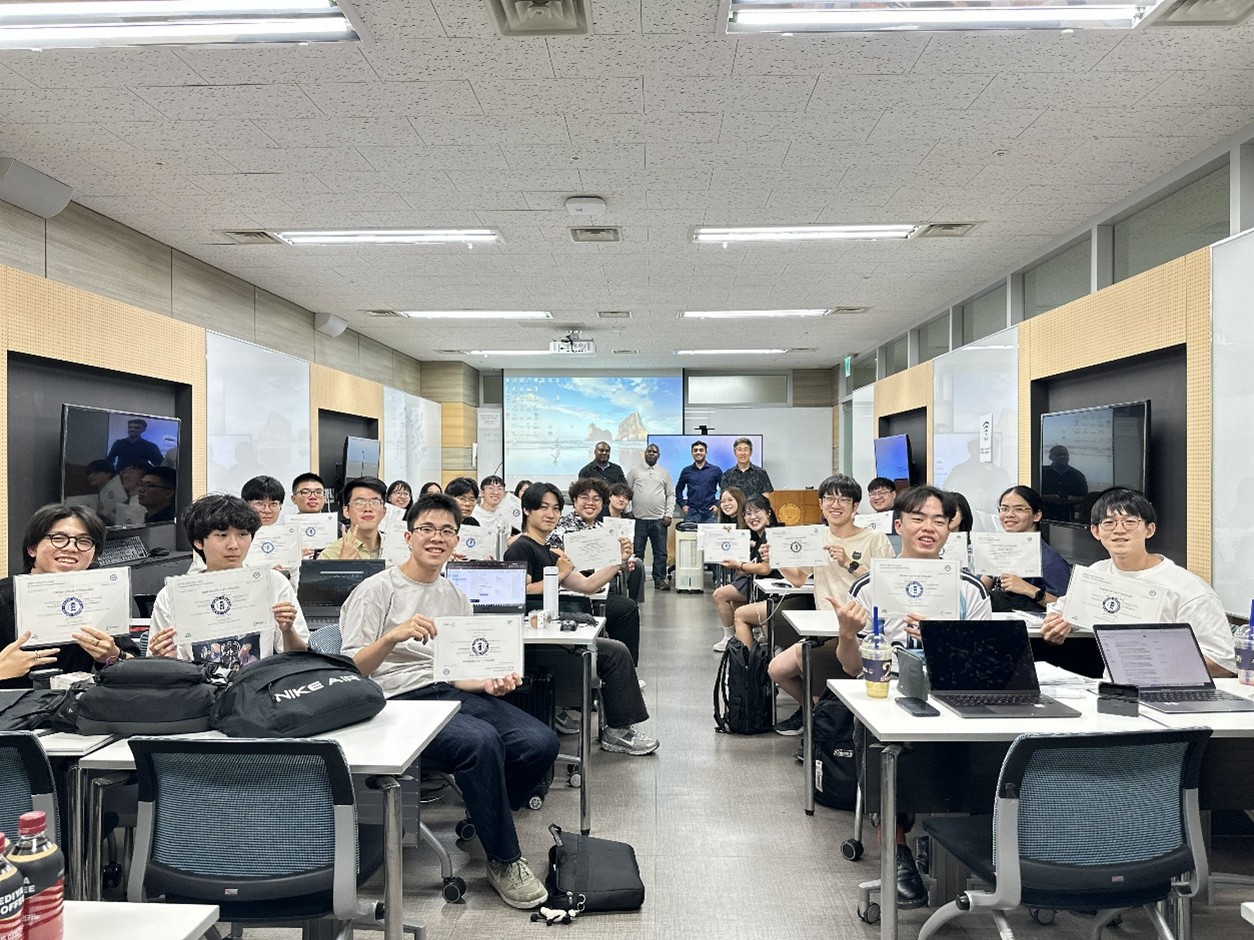
Taiwan Tech students complete the 6G RAN practical workshop and receive certificates of participation, demonstrating the outcomes of their overseas hands-on learning experience.