


Taiwan Tech researcher, Liang-Ting Wu, wins Hon Hai Award for 96% accurate AI battery predictions.[10 Aug. 2026]
Liang-Ting Wu, a doctoral student in the Department of Chemical Engineering at Taiwan Tech, has developed a structural prediction model for layered oxide cathode materials used in sodium-ion batteries by combining artificial intelligence with first-principles thermodynamic calculations under the supervision of Professor Jyh-Chiang Jiang. Based on material composition, the model can predict the crystal structure most likely to form, achieving an accuracy rate of approximately 96%. The research could help shorten the development time for new materials and reduce the costs associated with trial and error. The findings were published in Advanced Energy Materials, a leading international journal in energy materials. With joint recommendations from Chair Professor Bing-Joe Hwang and Professor Yu-Cheng Chiu, Wu also received recognition in the Application Category of the 2026 Hon Hai Award, which was newly introduced that year. The achievement highlights Taiwan Tech’s strong research capabilities in energy materials, artificial intelligence, and international research collaboration.
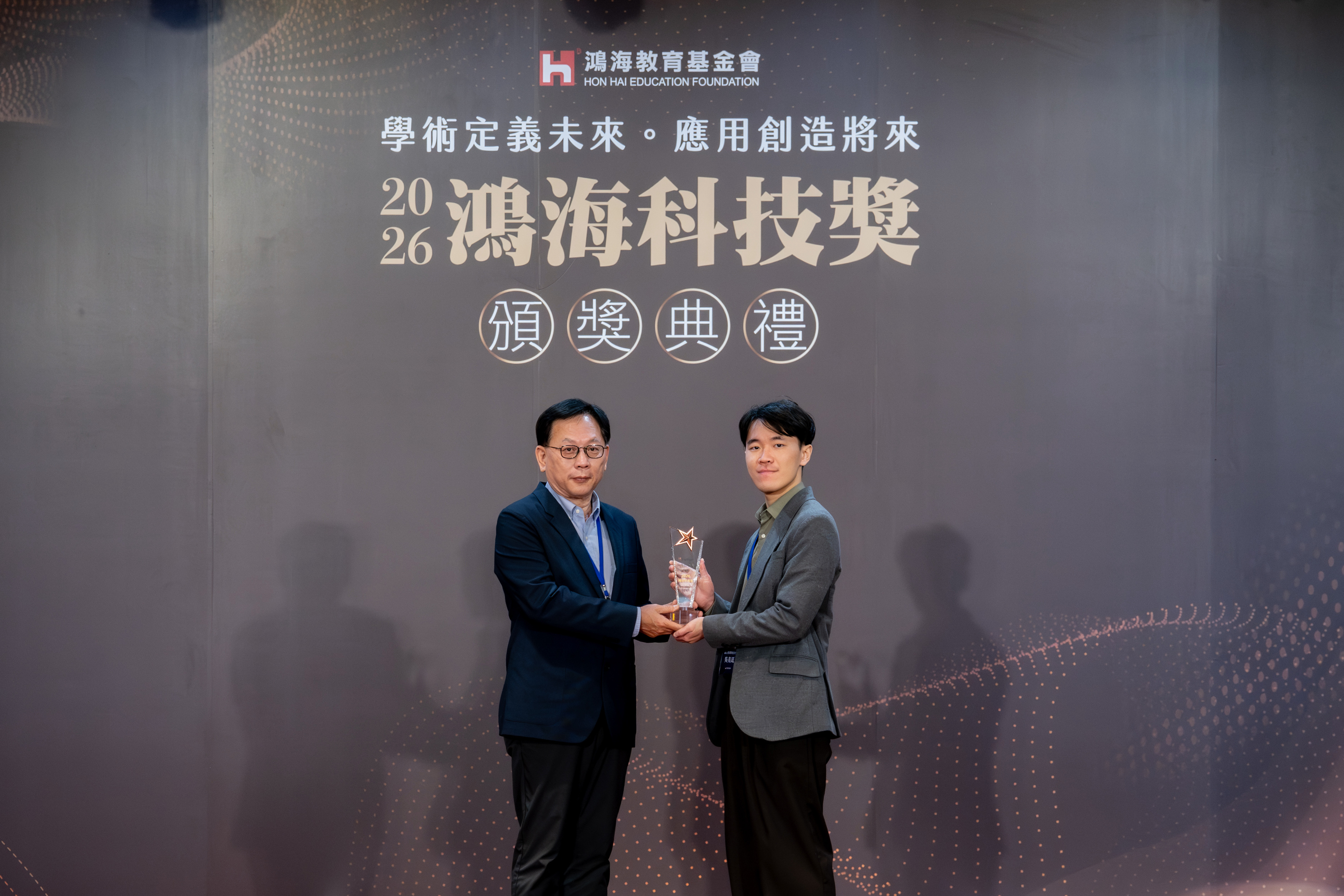
Doctoral student Liang-Ting Wu (right) of the Department of Chemical Engineering at Taiwan Tech receives recognition in the Application Category of the 2026 Hon Hai Award at the award ceremony. His research demonstrates Taiwan Tech’s strength in interdisciplinary research combining artificial intelligence and energy materials.
In recent years, the rapid development of renewable energy has made the development of safe, low-cost, and highly efficient energy storage systems a major challenge in the global energy transition. Although lithium-ion batteries, which are currently widely used, have reached a high level of technological maturity, the cost and supply constraints of lithium resources have led to growing interest in sodium-ion batteries. Because sodium is abundant and inexpensive, sodium-ion batteries are regarded as an important direction for next-generation energy storage technologies. However, the design of cathode materials for sodium-ion batteries remains challenging. The crystal structure ultimately formed by a material directly affects battery capacity, cycle life, and sodium-ion transport efficiency.
Liang-Ting Wu explains that layered oxide cathode materials commonly used in sodium-ion batteries mainly form two types of stacking structures, P2 and O3, each with different characteristics. P2 structures generally offer better sodium-ion conductivity, while O3 structures provide higher initial capacity. Therefore, predicting which structure a material will ultimately form before synthesis has long been an important issue in materials design. Previous studies have often relied on relatively simple linear models for prediction, but their predictive capabilities remain limited when dealing with new materials with more complex compositions.
To improve prediction accuracy, the research team compiled data on 270 layered oxide materials that had been experimentally verified and established a comprehensive database. The team also extracted key material features, including sodium concentration, transition-metal ion potential, ionic radius, ionization energy, and mixing entropy, and compared the predictive performance of multiple machine-learning models. The results showed that a deep neural network could effectively learn complex nonlinear relationships among different material features, achieving an accuracy rate of approximately 96% on test data that were not used during training. Further validation using 80 new materials reported in recent literature showed similarly strong predictive performance, demonstrating the model’s reliability and potential for practical applications.
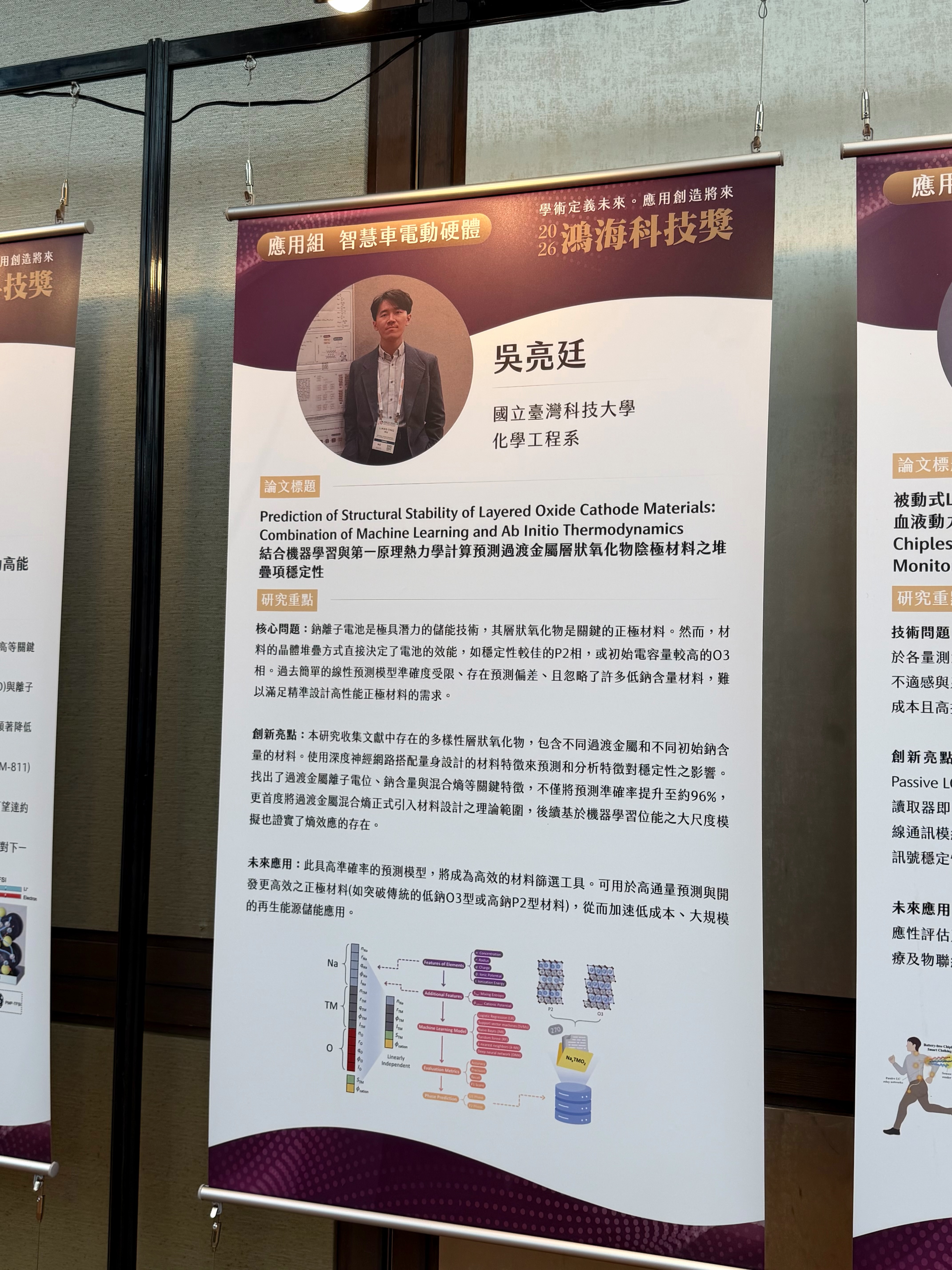
Doctoral student Liang-Ting Wu of Taiwan Tech’s Department of Chemical Engineering received recognition in the Application Category of the 2026 Hon Hai Award for his research, “Predicting the Stacking Phase Stability of Transition-Metal Layered Oxide Cathode Materials by Combining Machine Learning and First-Principles Thermodynamic Calculations”. The study uses artificial intelligence to develop a structural prediction model for sodium-ion battery cathode materials, helping accelerate the development of new materials.
In addition to developing a highly accurate prediction model, the research further revealed the key mechanisms influencing the formation of material structures. The team found that transition-metal ion potential, sodium content, and transition-metal mixing entropy are the three key factors affecting whether a material forms a P2 or O3 structure. Mixing entropy represents the diversity of different metal elements and the uniformity of their composition within a material. The study found that higher mixing entropy helps stabilize the O3 structure, providing a new research direction for developing novel battery materials through elemental design.
Notably, the study did not rely solely on AI for data analysis. The researchers further combined electrostatic analysis, density functional theory (DFT), Monte Carlo simulations, and thermodynamic analysis to verify, at the atomic scale, the patterns identified by machine learning. The results confirmed that interactions among sodium ions, transition metals, and other sodium ions, as well as the mixing entropy effect of the material, do indeed influence structural stability. This gives the AI predictions a solid physical and chemical foundation rather than relying solely on statistical correlations.
The research grew out of Taiwan Tech’s long-standing commitment to international collaboration. During his doctoral studies, Liang-Ting Wu visited Forschungszentrum Jülich in Germany, where he collaborated with Professor Payam Kaghazchi’s research team and gained access to extensive data on sodium-ion battery materials as well as first-principles simulation techniques. After returning to Taiwan, under the guidance of his advisor, he combined Taiwan Tech’s expertise in energy materials with AI-based analytical methods to develop and theoretically validate the model. The research findings were subsequently published in international journals.
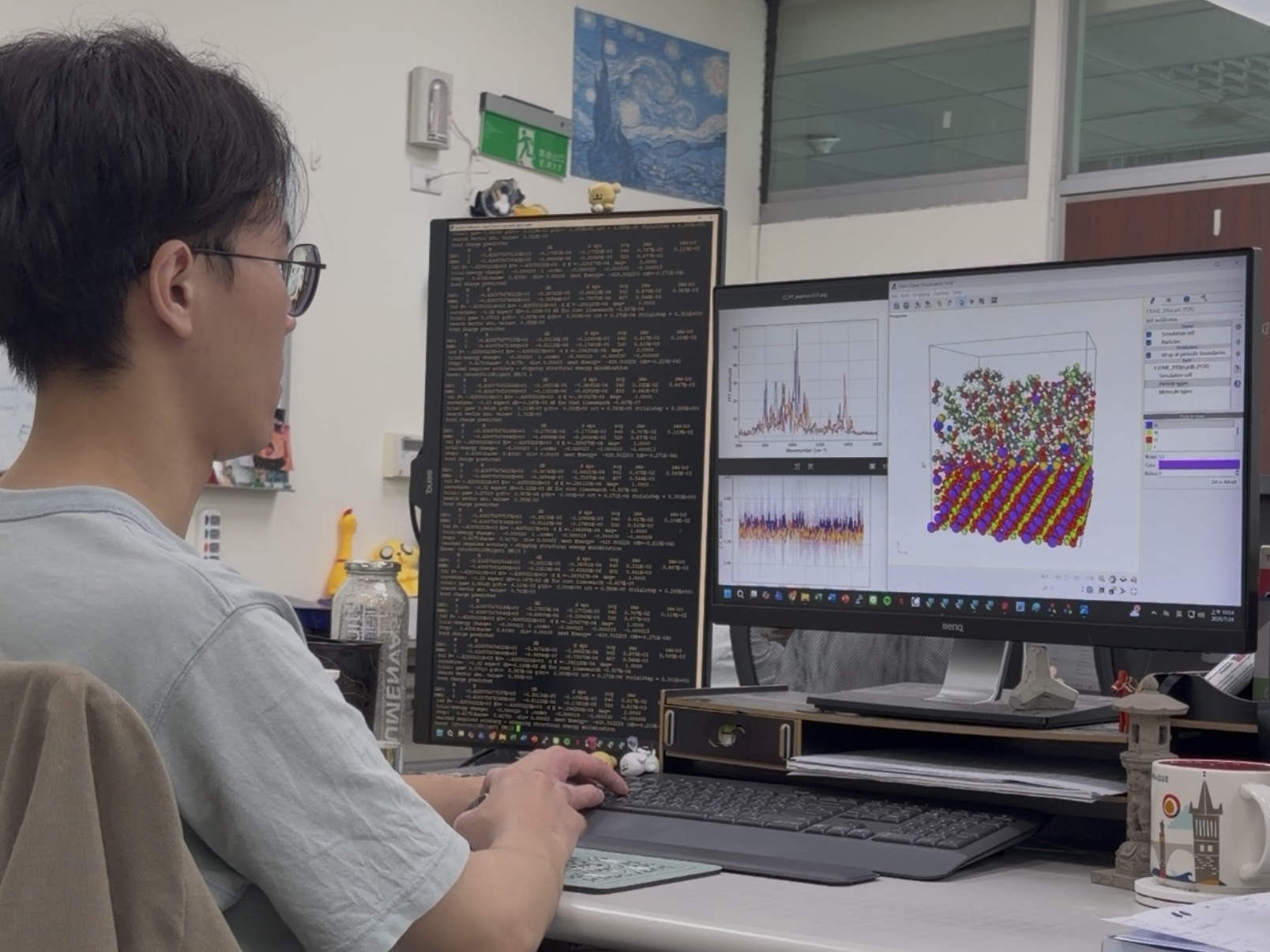
Liang-Ting Wu conducts materials simulations and data analysis on a computer in the laboratory, using artificial intelligence combined with first-principles thermodynamic calculations to develop a structural prediction model for sodium-ion battery cathode materials.
Liang-Ting Wu completed his bachelor’s, master’s, and doctoral studies in the Department of Chemical Engineering at Taiwan Tech. He says that Taiwan Tech provides well-equipped research facilities, an interdisciplinary research environment, and opportunities for international exchange, enabling students to develop comprehensive research capabilities ranging from materials design and theoretical simulations to AI-based analysis. These resources also helped create the opportunity for collaboration with the German research team. He candidly admits that he initially believed simulation research was still some distance from industrial applications. However, after receiving the Foxconn Science and Technology Award, he gained a deeper appreciation of the practical value of artificial intelligence and materials simulation for the new energy industry.
In recent years, Taiwan Tech has continued to promote research in artificial intelligence, energy technologies, and international collaboration, encouraging students to engage in interdisciplinary innovation. Through theoretical analysis, experimental validation, and international exchange, the university nurtures talent with capabilities in both fundamental research and industrial applications. This research not only demonstrates Taiwan Tech’s strong capabilities in new energy materials research, but also provides a new direction for using artificial intelligence to support materials design. In the future, it may help accelerate the development of next-generation sodium-ion battery materials and contribute innovative solutions to the global energy transition and sustainable development.


