Taiwan Tech hosts Taiwan–Switzerland Tech Forum to strengthen strategic partnership.[ 30 Jan. 2026]
Since 2020, Taiwan’s National Science and Technology Council (NSTC) and the Swedish Foundation for Strategic Research (SSF) have jointly promoted a flagship bilateral cooperation program focusing on key technological fields, including semiconductors and quantum technology, next-generation communications (6G), artificial intelligence, sustainability and green energy, and advanced materials. To date, the two sides have jointly supported multiple research projects with strong international competitiveness and high application potential, thereby successfully establishing a solid, long-term collaborative network between leading research teams in Taiwan and Sweden.
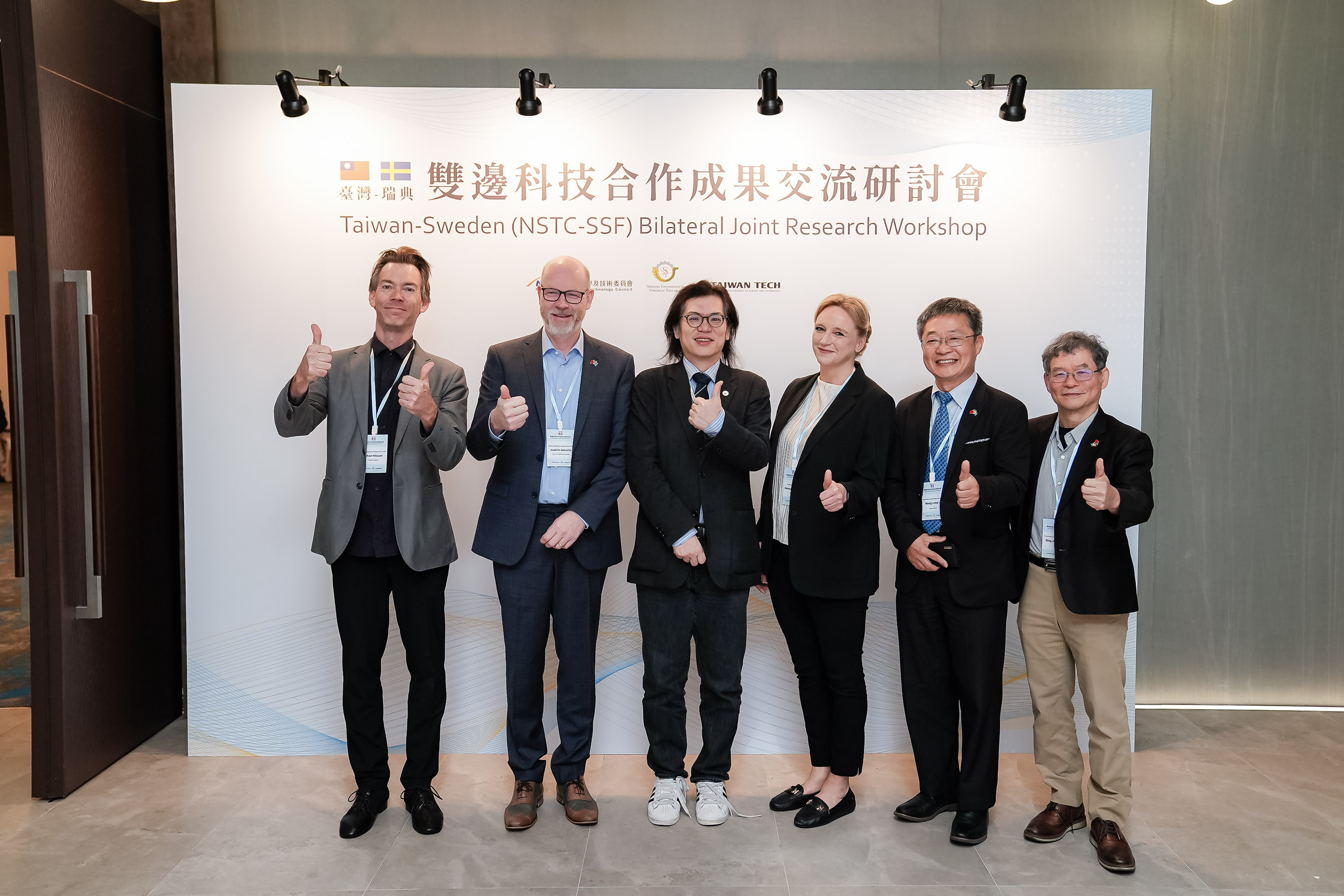
From left to right: Johan Nilsson, Scientific Secretary of the Swedish Foundation for Strategic Research (SSF); Joakim Amorim, Research Program Manager of SSF; Bing-Yu Chen, Deputy Minister of the National Science and Technology Council (NSTC); Helena Reitberger, Representative of Sweden to Taiwan; Wang-Long Li, Director-General of the Department of International Cooperation and Science Education, NSTC; and Bing-Joe Hwang, National Chair Professor of the Department of Chemical Engineering, Taiwan Tech.
The Taiwan–Sweden (NSTC–SSF) Bilateral Joint Research Workshop, hosted by Taiwan Tech, was held in Yilan from January 29 to 30. The workshop comprehensively showcased recent collaborative achievements between NSTC and SSF and jointly outlined the blueprint for the next phase of bilateral scientific cooperation from 2026 to 2031. The discussions focused on semiconductors, quantum technology, and green energy to continuously strengthen the strategic partnership between Taiwan and Sweden in cutting-edge technological fields.
In his opening remarks, NSTC Deputy Minister Bing-Yu Chen stated that NSTC and SSF re-signed a Memorandum of Understanding (MOU) in July 2024, formally establishing the second-phase cooperation framework for 2026–2031. The new phase expands collaboration into ten major strategic areas. In addition to continuing strengths in semiconductors and artificial intelligence, the cooperation now includes space technology, quantum technology, unmanned aerial vehicles and robotics, neuroscience, and ocean exploration technologies. This workshop not only served as a platform to present and exchange the achievements of the past five years, but also facilitated matchmaking among research teams for newly launched funding calls. He also expressed sincere appreciation to Professor Bing-Joe Hwang of Taiwan Tech and his team for their assistance in planning and hosting the workshop.
Helena Reitberger, Representative of Sweden to Taiwan, also attended the workshop and delivered opening remarks. She noted that Sweden and Taiwan share a long-standing and comprehensive cooperative relationship, particularly in scientific research collaboration between SSF and NSTC, which has received strong recognition. She further mentioned that the Swedish Trade and Invest Council in Taiwan and Taiwan’s Ministry of Education are currently discussing a reciprocal scholarship program to actively promote bilateral talent cultivation and academic exchange between Sweden and Taiwan.
The workshop brought together principal investigators from both Taiwan and Sweden participating in the first phase (2020–2025) of the bilateral cooperation program, along with members of their core research teams. Research topics covered a wide range of frontier areas, including GaN high-frequency and high-power devices (HEMTs), solid-state anode-free lithium batteries, two-dimensional quantum optoelectronic devices, vacuum electronic chip technology, beyond-5G antenna technologies, and CMOS nanopore biosensing. Through research presentations and in-depth discussions, the workshop promoted interdisciplinary integration and technological breakthroughs.
National Chair Professor Bing-Joe Hwang of the Sustainable Electrochemical Energy Development Center (SEED Center) at Taiwan Tech integrated faculty members with diverse expertise from within the university, including Professor Jyh-Chiang Jiang from the Department of Chemical Engineering, Professor Wei-Nien Su from the Graduate Institute of Applied Science and Technology, and Professor Shih-Yun Chen from the Department of Materials Science and Engineering. Professor Jiang specializes in theoretical chemical computation, Professor Su focuses on polymer electrolytes for batteries, and Professor Chen specializes in transmission electron microscopy analysis. They collaborated with a world-class research team from Uppsala University in Sweden, including Professor Daniel Brandell, Professor Jonas Mindermark, and Professor Maria Hahlin. Professor Brandell specializes in theoretical modeling, Professor Mindermark in polymer design and synthesis, and Professor Hahlin in XPS surface analysis. The two teams demonstrated a high degree of complementarity, focusing their joint research on the development of solid-state polymer electrolyte anode-free batteries. Over the five-year collaboration period, the team published 20 high-quality journal articles and established multiple in situ spectroscopic imaging and theoretical computation platforms, laying a strong foundation for future collaboration.
In addition to research result exchange, the workshop also featured dedicated sessions for doctoral students and early-career researchers, as well as thematic discussions on industry–academia collaboration and the industrialization of research outcomes. These initiatives aim to further extend the bilateral cooperation results into talent development, industrial linkages, and long-term institutionalized collaboration mechanisms, thereby comprehensively enhancing Taiwan’s key role within the global scientific research network. The workshop represents not only an important milestone in Taiwan–Sweden scientific collaboration but also a solid foundation for the next phase of larger-scale, more impactful international cooperation.
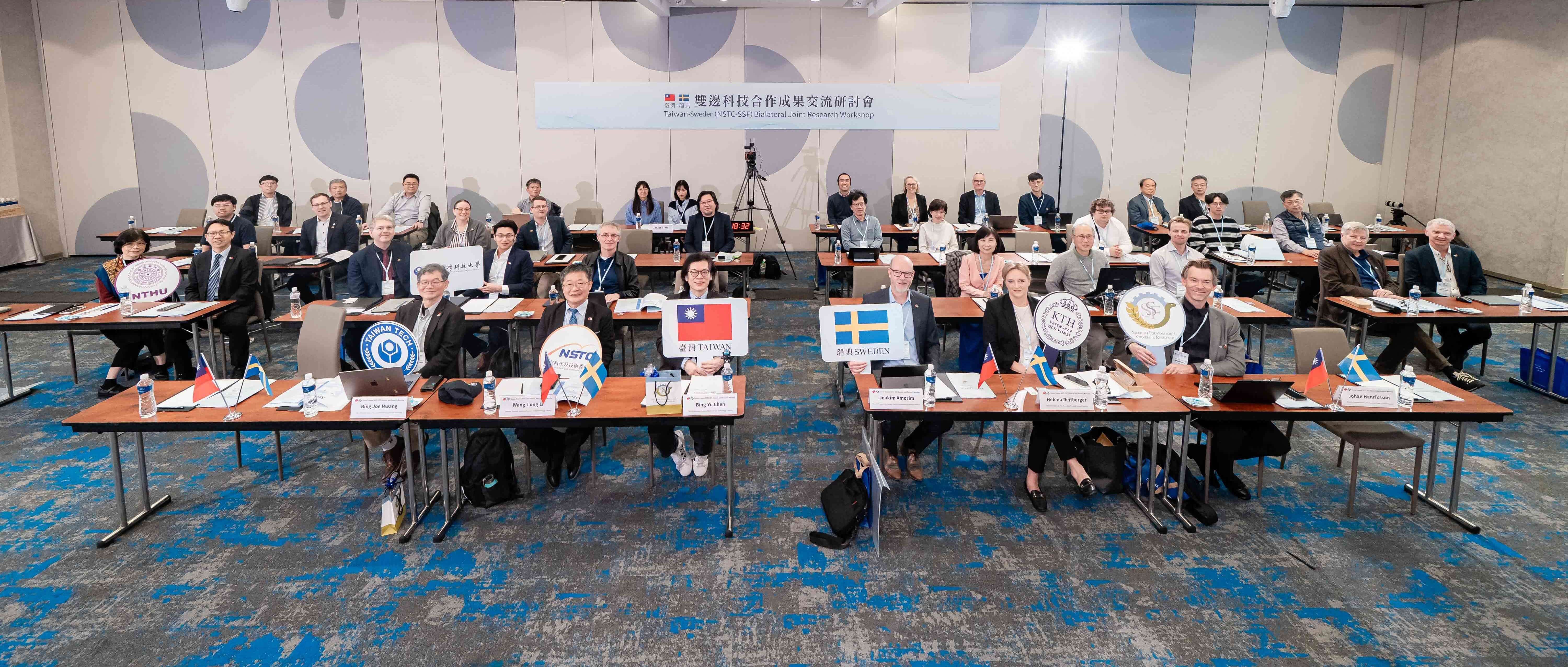
Group photo of the workshop participants.