


IFAT 2026 Emerges as a Blueprint for Global Academic Synergy in the Tech Frontier.[26 Mar. 2026]
The 12th International Forum on Advanced Technologies (IFAT 2026), recently hosted by Tokushima University (TU) in Japan, has further solidified its reputation as a premier stage for international academic synergy. Co-organized with the National Taiwan University of Science and Technology (Taiwan Tech), this year's forum transcended traditional academic boundaries. By showcasing the fusion of diverse expertise from semiconductor engineering to digital social sciences, the event demonstrated the interdisciplinary collaboration essential for solving the complex challenges of the 21st century.
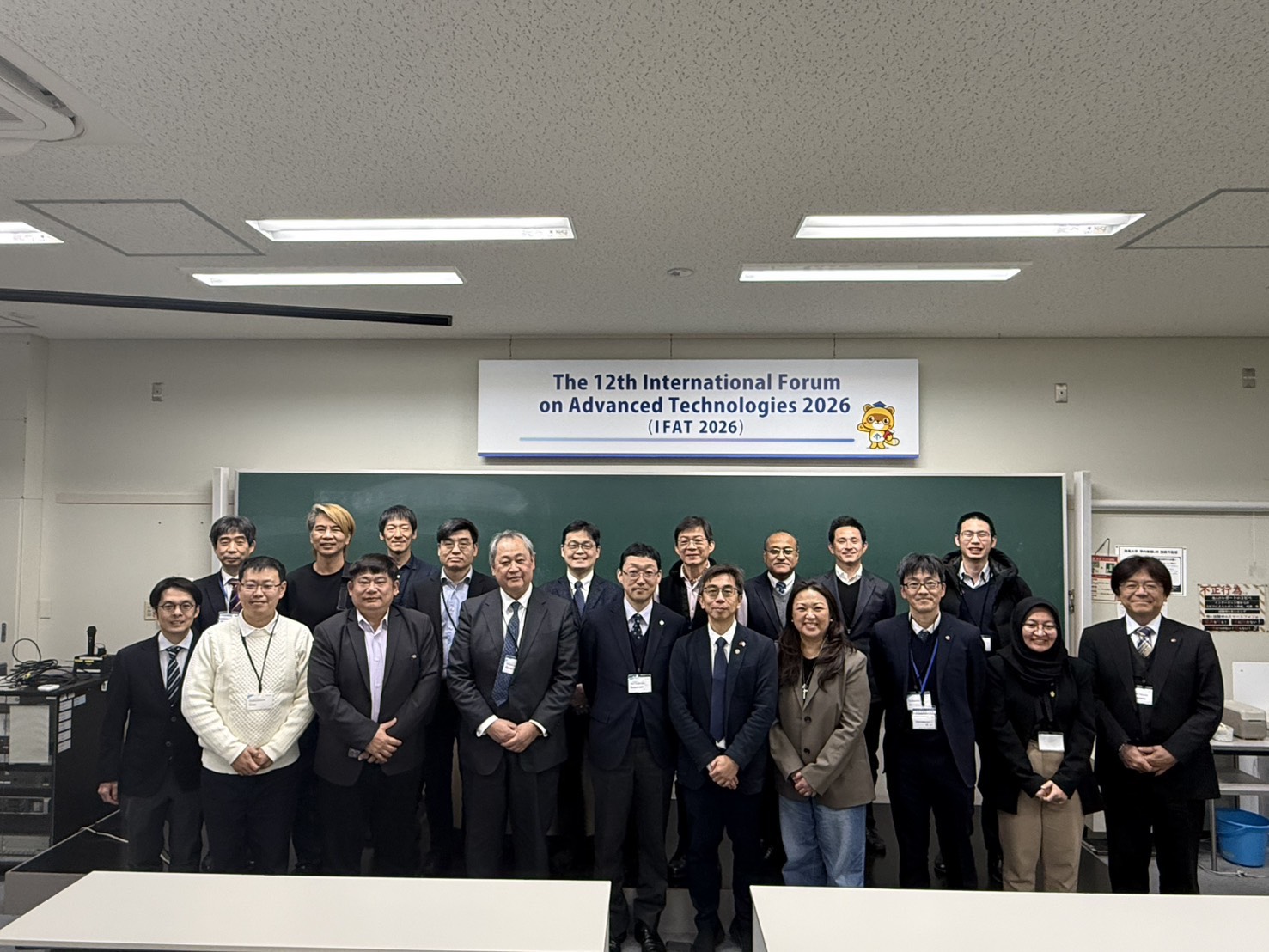
Distinguished attendees and keynote speakers at IFAT 2026.
The foundations of IFAT date back to June 26, 2014, with the establishment of the Tokushima University Education and Research Center at Taiwan Tech. More than just an office, this center serves as a vital bridge for bilateral research. Since the inaugural forum in 2015, IFAT has rotated annually between the scenic campus of Tokushima and the bustling tech hub of Taipei.
For an institution with a 50-year legacy, this partnership stands as a rare and significant milestone. It serves as a testament to a deeply rooted, enduring relationship built on shared values. The strength of this bond is evidenced by:
• Academic Output: Over the past 13 years, the two universities have funded 69 bilateral projects and jointly published 96 academic papers.
• Resilience: Even the disruptions of the global pandemic could not sever these ties; the community pivoted to virtual formats in 2020 and 2021 to ensure unbroken collaborative discovery.
• Expansion: Today, the IFAT community includes prestigious partners like the Kyushu Institute of Technology (Kyutech), further enriching the forum's intellectual divers
The keynote addresses provided the intellectual scaffolding for IFAT 2026, centering on the themes of "Resilience and Transformation."
• "Intellectually Circular" Research: Prof. Yasunori Muto (Dean, TU) and Prof. Wei- Nien Su (Associate VP for R&D, Taiwan Tech) opened the forum by emphasizing that modern research must allow ideas to flow across borders to solve local problems.
• The "Twin Transitions": Materials scientists, including Prof. Yian Tai, discussed the intersection of green and digital growth. Their research into self-assembled monolayers (SAMs) on copper surfaces is critical for the next leap in semiconductor efficiency.
• Human-Centric Technology: A standout session by Prof. Hiroyuki Mitsuhara and Prof. Cathy Weng explored "The Necessity of Realism in Disaster Training". By integrating 3D city modeling with social-emotional nuances, they demonstrated that advanced technology must remain fundamentally human-centric.
This year's program covered an expansive spectrum of critical technological domains:
• Nanotechnology & Advanced Materials: Innovations in high-entropy ceramics for Li-ion batteries and spray-based fabrication of ceramic powders.
• Biotechnology & Health: Breakthroughs in non-enzymatic lactate sensing and real- time in vivo dopamine monitoring.
• Digital Transformation & AI: Deep dives into density-aware computer vision and the integration of AI in sustainable industrial processes.
• Civil Engineering & Infrastructure: New techniques for the retrofitting and deterioration monitoring of civil structures.
The success of IFAT 2026 was primarily anchored in the robust academic leadership shared between Japan and Taiwan. The opening ceremony, co-chaired by Professor Hironori Muto of Tokushima University and Professor Wei-Nien Su, Associate VP for Research and Development at Taiwan Tech, established a sophisticated tone for the day's high-level technical exchanges. In the inaugural materials science session, Professor Yi-An Tai detailed critical surface effects within semiconductor manufacturing, while Professor Ken Yoshida presented a leading-edge analysis of metal corrosion prevention mechanisms. This was followed by Professor Yu-Chen Chou and Professor Masatsugu Oishi, who introduced groundbreaking research on advanced ceramic powder manufacturing and high-entropy cathode materials for lithium-ion batteries, respectively, effectively showcasing the forum's forward-looking perspective on the energy and manufacturing sectors.
The forum then seamlessly transitioned into the practical application of "smart healthcare" and "environmental sustainability." Within the field of sensing technology, Dr. Mia Rinawati and Professor Min-Hsin Yeh demonstrated an ultra-sensitive lactic acid sensor for sweat detection, while Professor Hitoshi Mizuguchi shared significant breakthroughs in vivo dopamine monitoring. Furthermore, Professor Chang-Mou Wu presented innovative Janus membrane technology, which harnesses solar energy to achieve simultaneous dye degradation and heavy metal reduction, highlighting the immense potential of cutting-edge technology in environmental remediation.
The event reached its climax with the cross-domain integration of "Digital Technology and Social Security." Professor Kang Xin proposed advanced AI image recognition for crowd
counting, while Muhammad Fajar Faliasthiunus Pradipta explored pioneering applications in fiber optic sensing and terahertz communication. Most notably, Professors Hiroyuki Mitsuhara and Cathy Weng jointly presented research on 3D city models and virtual avatars. Their work emphasized the vital role of "realism" in disaster training for educational psychology, perfectly embodying the mission of IFAT 2026: transforming advanced technology into tools for humanistic care and social resilience.
As the forum concluded, the organizing committees outlined an ambitious roadmap to deepen this "Global Partnership for the Goals" (SDG 17):
1. Sustainable Research Funding: The conference highlighted the continued success of the co-funding Research Program, which provides competitive grants per project to support travel, equipment acquisition, and student researcher involvement, fostering impactful and collaborative research initiatives.
2. Double Degree Programs (DDP): A primary goal for 2026-2027 is the expansion of the Joint Doctoral Programs, allowing students to receive guidance from supervisors at both TU and Taiwan Tech, effectively training "global citizens" in science and engineering
3. Digital Integration & SDGs: Building on the work of scholars like Prof. Cathy Weng, future forums will emphasize generative AI and multimodal narratives to bridge the gap between technical skills and social-emotional learning.
4. Industry-Academia "Lab-to-Market" Pipeline: Increasing involvement from industrial partners to ensure that lab-scale breakthroughs like the Janus membranes for water purification, are rapidly scaled for public benefit.
IFAT 2026 has proven that while technology is the tool, collaboration is the engine of progress. The bonds strengthened this year in Tokushima will serve as the launchpad for the next generation of global innovators, ensuring that the legacy of TU and Taiwan Tech continues to thrive.


