


Professor Ping-Chun Tsai’s research team at Taiwan Tech unveils key mechanism for fast-charging batteries.[11 May. 2026]
A research team led by Associate Professor Ping-Chun Tsai of the Department of Mechanical Engineering at Taiwan Tech has made significant advances in solid-state battery material design by developing a novel “computation-driven experimentation” framework. Integrating theoretical calculations, machine learning, and materials experimentation, the framework establishes a new paradigm in which computational analysis guides material design, moving materials science beyond traditional trial-and-error optimization toward predictive design. The team's findings were published in “Advanced Energy Materials”, one of the leading journals in the field of energy materials. The research was selected as the journal’s Back Cover feature and highlighted as a Hot Topic. The team was also invited to present its work at the Materials Research Society (MRS) conference in the United States.
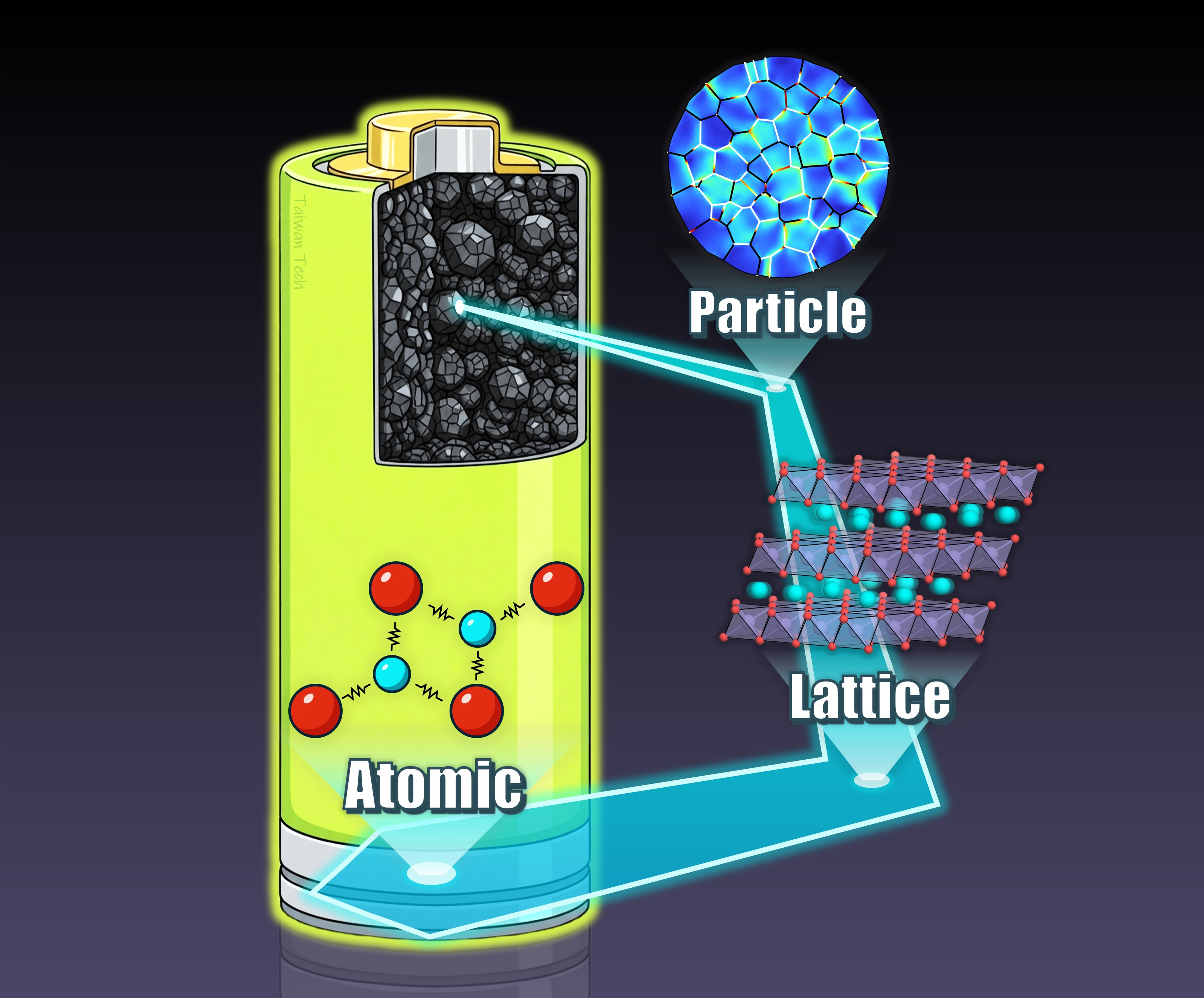
The research team developed a computation-driven experimental framework that integrates theoretical calculations, machine learning, and experimental characterization into a multiscale lithium-battery materials research platform.
For many years, cracks in lithium-battery electrodes have been regarded as a major cause of battery performance degradation. However, whether such cracks fundamentally alter the intrinsic transport properties of materials has remained an unresolved scientific question. Using its computation-driven experimental framework, the Taiwan Tech team became the first to quantitatively analyze the coupling relationship between intrinsic lattice transport and crack-interface effects. The study revealed that cracks do not weaken a material’s intrinsic diffusion capability. Instead, overall transport behavior is primarily governed by interface and geometric effects associated with the cracks. This discovery fundamentally redefines the physical role of cracks in battery materials and provides a new theoretical perspective on battery degradation mechanisms.
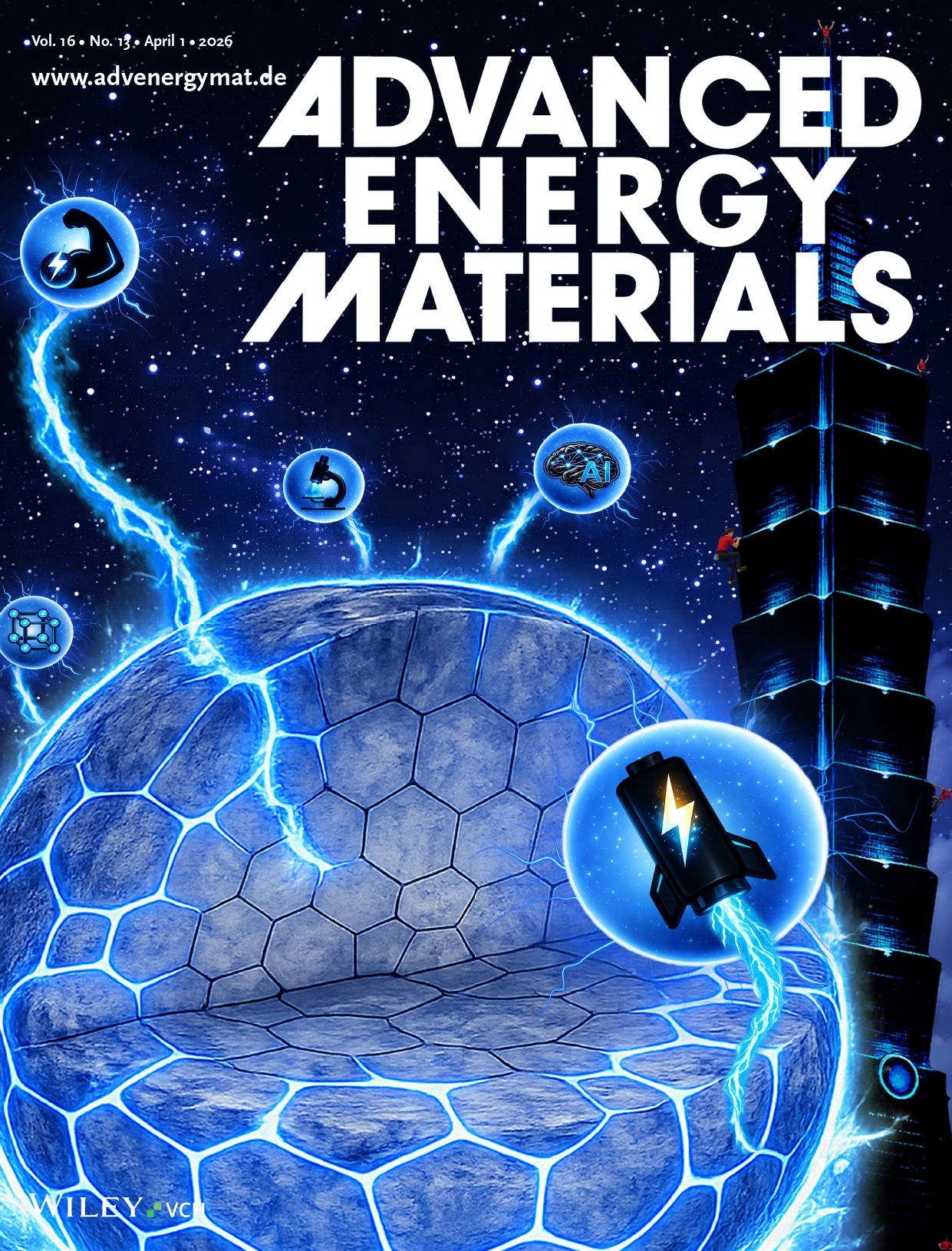
The team's research was featured as the Back Cover of Advanced Energy Materials. The cover artwork depicts a climb up Taipei 101, symbolizing the breakthrough beyond conventional understanding of material design and the advancement toward a new era of predictive materials engineering.
The findings provide critical physical insights for the design of high-energy-density, fast-charging, and long-lifetime lithium-ion batteries and are expected to have a significant impact on the development of next-generation lithium-ion and solid-state battery technologies. According to Associate Professor Tsai, the research not only resolves a longstanding scientific challenge but also establishes a computation-driven design methodology that can be extended across various material systems. The approach transforms material development from an experience-based process into a systematic and predictive engineering discipline.
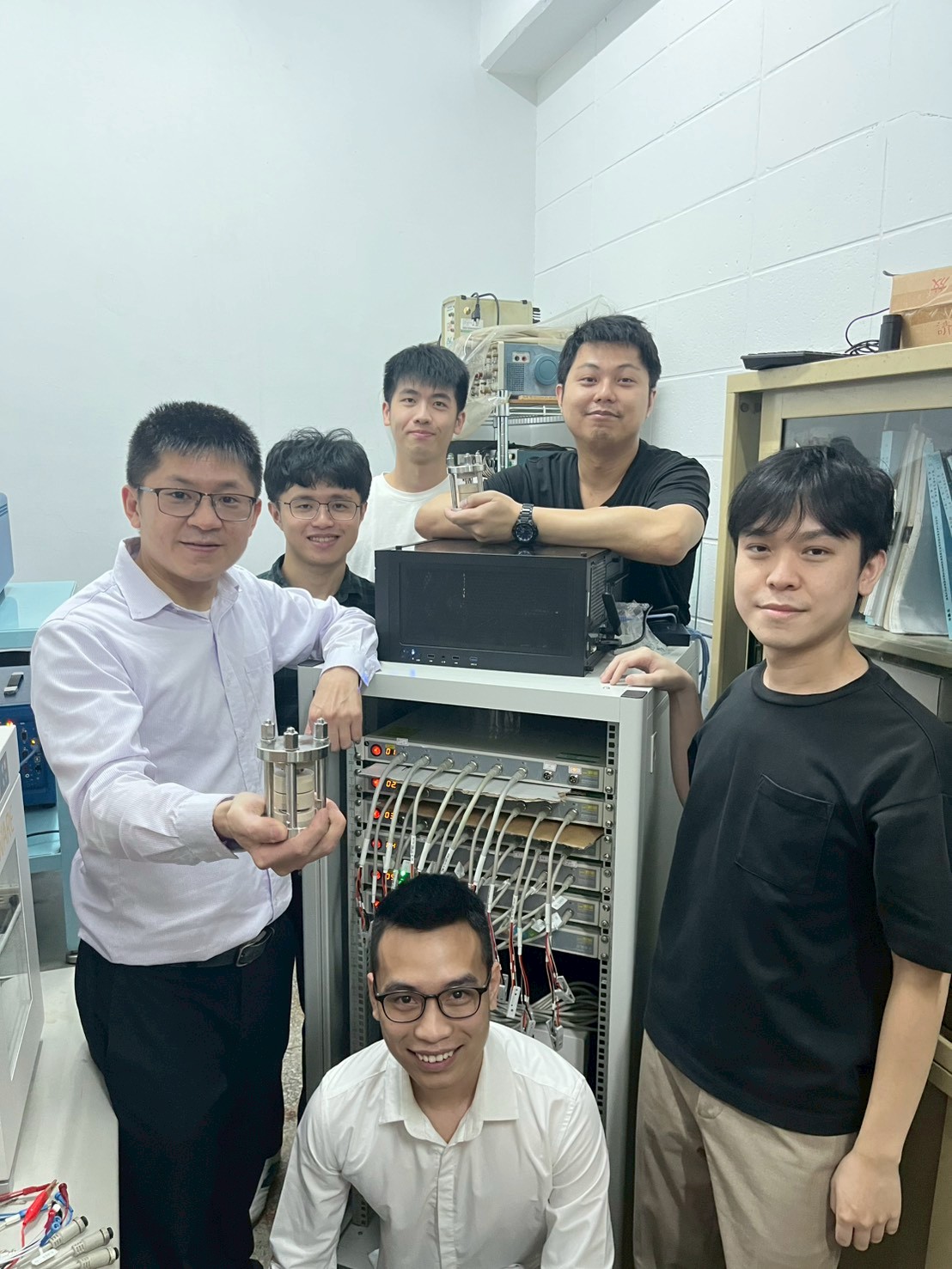
The Taiwan Tech research team, led by Associate Professor Ping-Chun Tsai (first from left), experimentally validated multiscale computational predictions regarding the impact of cracks on fast-charging performance.
Professor Tsai’s research group is dedicated to developing frameworks capable of predicting material behavior. By promoting computation-driven experimentation, the team aims to shift materials development away from empirical approaches and toward predictive design based on physical mechanisms and data-driven methodologies. Over the years, the group has focused extensively on solid-state battery materials, with related research published in internationally recognized journals including “Advanced Energy Materials, Chemical Engineering Journal, and Journal of Power Sources”. Through these contributions, the team continues to play a leading role in advancing computation-driven materials design and promoting a new paradigm of predictive materials science.
The research achievement represents the collective efforts of five consecutive generations of Taiwan Tech master’s students in the Department of Mechanical Engineering, including Chi-En Tseng, Chen-Hao Tu, Wei-Cheng Lai, Chao-Hsiang Hsu, Ching-Sen Yang, Yu-Sheng Cheng, and Hui-Huang Teng. Their work demonstrates the team’s long-term commitment to collaboration and innovation. Through training in computation-driven experimentation, students gain expertise in theoretical modeling, materials experimentation, and machine learning, enabling them to develop the interdisciplinary skills required to become internationally competitive researchers in the next generation of materials science.
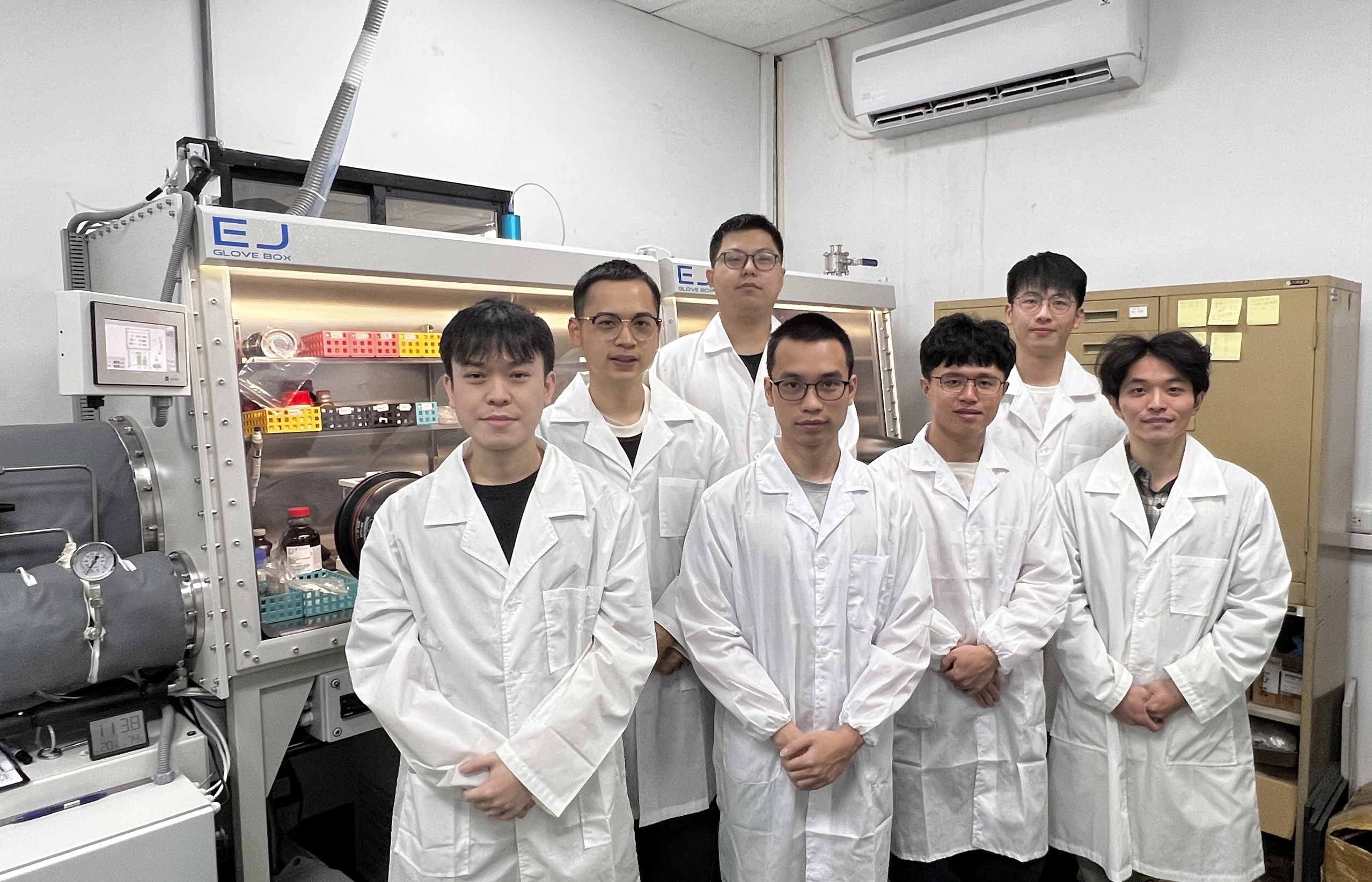
The research team from Department of Mechanical Engineering at Taiwan Tech completed the project through long-term training in computation-driven experimentation, cultivating internationally competitive talent for the future of materials research.


